
11 Years Experience
Guiding expats since 2014.
Licensed Expertise
§34d certified broker.
200K+ Community
Verified by thousands.
Expert Verified
Fact-checked.
Quick Summary
Germany wants highly skilled freelancers, but the visa process presents a legendary bureaucratic hurdle. You cannot just show up in Berlin and declare yourself a freelancer. You must mathematically prove to the government that local economic interest in your work exists, that you hold a rock-solid business plan, and that German clients await you. Also, you must understand the strict legal divide between a Freiberufler (Freelancer) and a Gewerbetreibender (Tradesperson). Drawing on 11 years of advising expats, this comprehensive 2026 guide breaks down the exact documents, financial plans, and legal nuances you need to succeed, ensuring you avoid the mistakes that cause 40% of applications to fail.

« German bureaucracy is rigid but predictable. Treating your applications like legal documents rather than marketing flyers is the secret to getting a fast YES from any German office. »
In our 11 years guiding expats, we have reviewed thousands of freelance visa applications. The number one reason expats face rejection isn't a lack of talent or money, it's a fundamental misunderstanding of German state requirements.
The Ausländerbehörde (Foreigners' Office) acts as a risk-assessor. Their primary job is to ensure you will not become a financial burden on the German social system.
Let's translate the complexity of the German immigration system into absolute clarity. Here is your definitive, step-by-step roadmap to securing a Freelance Visa in Germany in 2026.
1. Do You Even Need a Visa? The Passport Rule
Your passport dictates your path entirely.
EU / EEA / Swiss Citizens
If you hold an EU/EEA or Swiss passport, stop reading the visa sections. Thanks to EU Freedom of Movement, you possess the absolute legal right to move to Germany and start freelancing tomorrow without any visa or business plan approval. You simply register your address (Anmeldung) and apply for a tax number (Steuernummer).
The "Privileged Nations" (Best Friends Rule)
Citizens of Australia, Canada, Israel, Japan, New Zealand, South Korea, the UK, and the USA hold a massive procedural advantage. You do not apply for a visa at the German embassy in your home country. You enter Germany on a standard 90-day tourist visa and apply for the Freelance Residence Permit directly at the local Ausländerbehörde inside Germany.
Third-Country Nationals
Citizens of all other non-EU countries (India, Brazil, South Africa, Turkey) must apply for a National Visa (Type D) specifically for self-employment at the German Embassy in their home country before traveling. You cannot enter on a tourist Schengen visa and convert it.
2. The Golden Rule: Freiberufler vs. Gewerbe
This distinction causes the most initial failures. In English, "freelancer" covers almost any independent work. In German tax and immigration law, independent work divides into two distinct legal categories. You must know exactly which one you fit, as the visa requirements differ completely.
Category 1: Freiberufler (Liberal Professions)
This represents the true "Freelance Visa" under § 21 Abs. 5 AufenthG. It applies strictly to specific catalog professions (Katalogberufe) requiring special academic, artistic, or creative qualifications.
- Who belongs here: Doctors, lawyers, tax advisors, engineers, architects, journalists, artists, graphic designers, independent teachers, and highly specialized software developers.
- The Visa Advantage: The barrier to entry is lower. Prove you have clients and can support yourself. You do not pay Trade Tax (Gewerbesteuer), you skip registering a commercial trade (Gewerbeanmeldung), and accounting remains simpler.
Category 2: Gewerbetreibender (Self-Employed / Tradesperson)
If you buy and sell goods, manufacture, or run a commercial agency, you operate a business under § 21 Abs. 1 AufenthG.
- Who belongs here: E-commerce sellers, restaurant owners, craftspeople, import/export agents, and general business consultants without specialized academic degrees.
- The Visa Disadvantage: Requirements are significantly harder. You must prove an overriding "economic interest" or "regional need." You must show your business positively impacts the local economy (creating jobs or investments). You must register a trade, pay Chamber of Commerce (IHK) fees, and potentially pay Trade Tax.
The Tax Office Has the Final Say
The Ausländerbehörde might grant a freelance visa, but the Finanzamt (Tax Office) finally decides if your profession qualifies as freiberuflich or gewerblich when issuing your tax number. If they classify you as a Gewerbe (commercial business), immediately inform the Ausländerbehörde to update your residence permit, or risk violating your visa terms.
3. In Detail: The Application Process & Document Checklist
Securing the freelance visa means proving absolute stability. Your paperwork must be flawless. Missing one document triggers immediate rejection or a weeks-long delay.
1. Secure Compliant Health Insurance
criticalYou cannot apply without proof of adequate health insurance. Since you are not an employee, you cannot easily join the public system upon arrival. Most new freelancers must purchase comprehensive private expat health insurance (like Care Concept or Ottonova) to get visa approval. The Ausländerbehörde almost always rejects travel insurance or basic "digital nomad" insurance.
2. Gather Letters of Intent (Absichtserklärungen)
criticalThe government demands proof you will make money upon arrival. You need at least two "Letters of Intent" from potential clients (strictly preferring German-based clients) stating their intent to hire you once your visa is approved. These are formal statements of genuine business interest on company letterhead, not legally binding contracts.
3. Prepare the Financial and Business Plan
requiredThe core of your application. Submit a detailed Business Plan, a Revenue Forecast (Ertragsvorschau), and a Capital Requirement Plan (Kapitalbedarfsplan). Show your expected income versus living and business expenses for the next 3 years to prove you will not need state welfare.
The Master Document Checklist
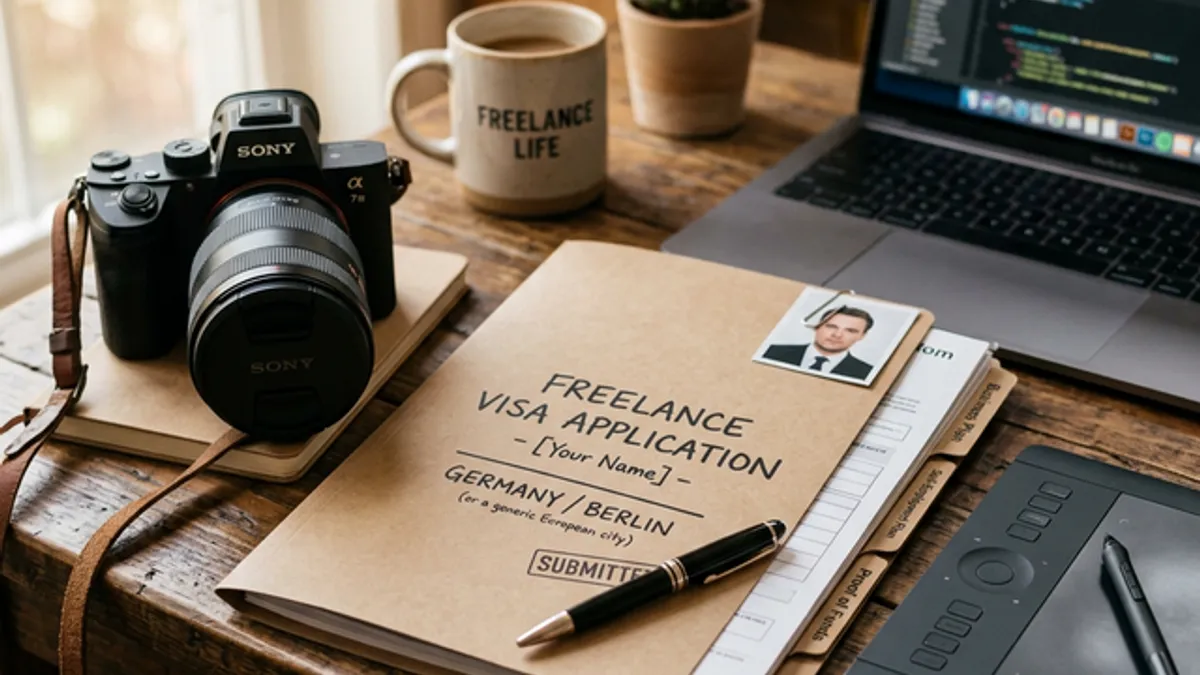
Print your portfolio, organize it neatly in a binder, and ideally translate it into German. Never submit loose, wrinkled papers.
Freelance Visa Application Portfolio
- Valid Passport & Biometric Photo (Max 6 months old)Source: Yourselfeasy
- Completed Application Form (Antrag auf Aufenthaltstitel)Source: Ausländerbehördeeasy
- Letters of Intent (Min. 2 German Clients)Source: Future Clientshard
- Business Plan & Revenue ForecastSource: Yourself / Accountantmedium
- Proof of Compliant Health InsuranceSource: Insurance Providermedium
- University Degree / Professional Portfolio / CVSource: University / Yourselfeasy
- Bank Statements (Proof of Savings, ideally EUR 10k+)Source: Your Bankeasy
- Anmeldung (Registration Certificate)Source: Bürgeramtmedium
- Rental Contract & Proof of Rent Cost (Warmmiete)Source: Landlordeasy
The Age 45 Pension Rule (Extremely Important)
If you apply for the first time and are over 45, a strict, non-negotiable requirement applies: You must prove adequate provision for old age (Altersvorsorge). Show proof of a significant private pension plan, real estate holdings, or life insurance guaranteeing a monthly payout (calculated around EUR 1,500/month) or a massive lump sum at age 67. This ensures you do not depend on state welfare in retirement.
4. How to Write a Winning Business Plan
Do not treat the business plan like a Silicon Valley pitch deck. Avoid buzzwords like "disruptive" or "hyper-growth." The immigration officer cares only about mathematical stability.
Your business plan must be sober, factual, and strictly financial:
- Executive Summary: What exactly do you do, and who are your target clients?
- Market Analysis: Why does Germany demand your specific skills? Are you filling a recognized shortage (IT, specialized consulting)?
- Marketing Strategy: How will you acquire new clients beyond your initial Letters of Intent?
- Revenue Forecast (Ertragsvorschau): A detailed, month-by-month spreadsheet predicting income and business expenses for 36 months.
- Capital Requirement Plan (Kapitalbedarfsplan): How much money do you need to launch (laptop, home office), and how are you funding it (savings)?
Hack: Hire a German business consultant. Spending EUR 300 to ensure your plan meets German formatting standards saves you a devastating rejection.
5. Artists and Creatives: The KSK Advantage
Freelance artists, publicists, musicians, and journalists access a uniquely German institution: the Künstlersozialkasse (KSK).
The KSK acts like a pseudo-employer for creatives. If accepted, the KSK pays exactly 50% of your public health, long-term care, and pension insurance contributions.
Mentioning your intent to apply for the KSK in your business plan proves you understand the German system. It drastically lowers your projected monthly expenses in your financial forecast, making it easier to prove you can support yourself. This adds massive credibility to your application.
6. The Ausländerbehörde Appointment Trap
Securing the physical appointment at the Ausländerbehörde is often the most stressful phase. Appointment systems in Berlin, Munich, and Frankfurt are chronically overloaded.
- The Reality: Waiting times for an initial appointment often exceed 4-6 months.
- The Strategy (Fiktionswirkung): If you enter visa-free (US, UK, Canadian citizens) for 90 days, you MUST apply for your appointment online before your 90 days expire. The moment you submit the contact form or book an appointment, your legal stay automatically extends via Fiktionswirkung (fiction effect) until your appointment date. You stay legally, but you absolutely cannot work or invoice clients during this wait.
- Our Direct Recommendation: Because you cannot work while waiting inside Germany, many "privileged" citizens choose to apply at the German Embassy in their home country. You secure the visa before flying, allowing you to invoice clients the day you land.
Frequently Asked Questions (FAQ)
What to read next
General Information & Legal Notice
The information provided in this article is for general educational purposes only and reflects our 11+ years of experience helping expats navigate German bureaucracy. It does not constitute formal legal, tax, or professional advice.
While we strive to keep our content accurate and up-to-date, immigration laws, tax regulations, and administrative processes in Germany change frequently. We are not lawyers or registered tax advisors. For individual cases, complex legal issues, or specific tax situations, we strongly recommend consulting a qualified German lawyer (Rechtsanwalt) or a certified tax advisor (Steuerberater).
About Oliver
Founder of expats.de, former cooperative bank advisor (Bankfachwirt IHK) with 12 years of banking experience, and a §34d licensed insurance broker. Since 2014, Oliver has helped over 10,000 expats navigate the German financial system. Read Oliver's full story →
Educational Notice & General Advice
This content is educational and reflects analysis based on our 11 years of market experience, our 200,000+ community insights, and current regulatory knowledge.
As a 34d-licensed insurance broker and experienced financial advisor, I provide this guidance in good faith. However, for personalized advice especially regarding insurance, mortgages, or tax-specific decisions—please consult with a qualified financial advisor or tax professional in your specific situation. Past expat experiences and historical market data do not guarantee identical results for your unique circumstances.