
11 Years Experience
Guiding expats since 2014.
Licensed Expertise
§34d certified broker.
200K+ Community
Verified by thousands.
Expert Verified
Fact-checked.
Quick Summary
In 2015, Germany introduced a strict federal law to combat registration fraud: You can no longer register an address (Anmeldung) using just a signed rental contract. You legally require a specific, standardized piece of paper signed by your landlord: the Wohnungsgeberbestätigung. Without this exact document, you absolutely cannot get your Anmeldung. Without the Anmeldung, you cannot get your tax ID, open a traditional bank account, or start working legally. This comprehensive 2026 guide explains what this document is, how to get it, what to do if your landlord refuses, and provides a free tool to generate the exact PDF your landlord must sign.

« German bureaucracy is rigid but predictable. Treating your applications like legal documents rather than marketing flyers is the secret to getting a fast YES from any German office. »
In our 11 years guiding expats, the Wohnungsgeberbestätigung causes the most immediate panic upon arrival. We see this 1,000+ times: a newcomer arrives in Berlin, miraculously secures an apartment, waits six weeks for a Bürgeramt appointment, and gets turned away in three minutes because they only brought their 20-page lease agreement.
The German registration system operates on pure, inflexible protocol. They do not care about your logical explanations; they care about the correct form.
Let's translate this bureaucratic hurdle into clarity. Here is everything you need to secure the Wohnungsgeberbestätigung without the stress.
1. In Detail: What exactly is the Wohnungsgeberbestätigung?
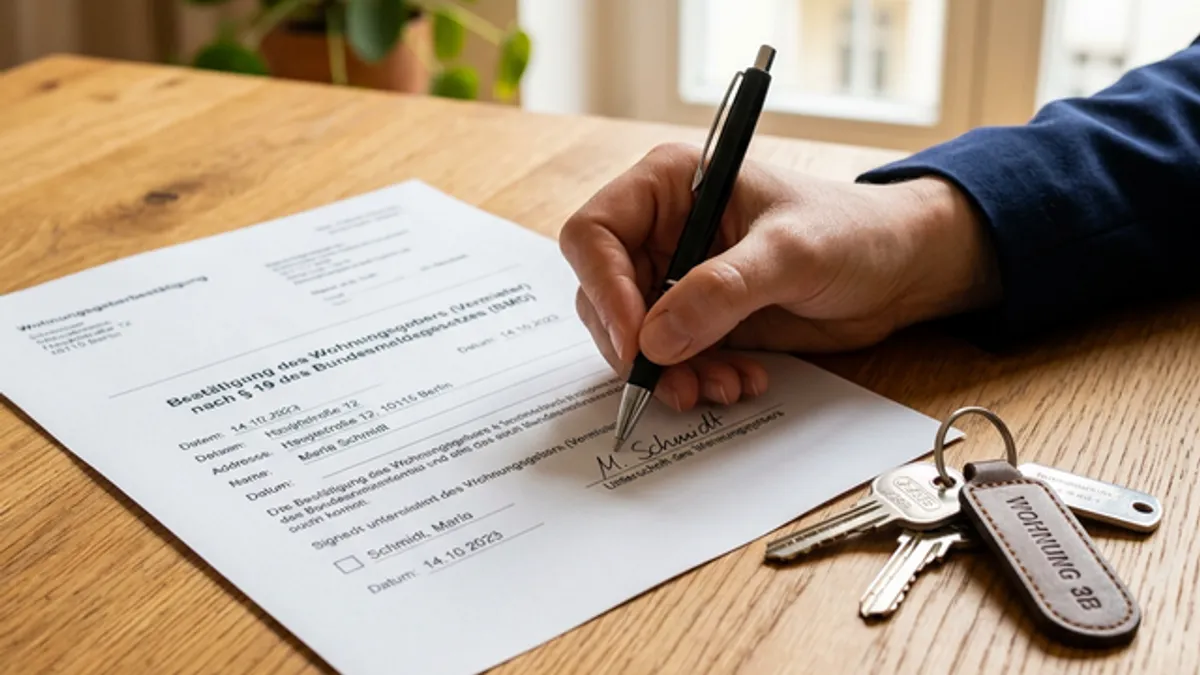
The Wohnungsgeberbestätigung (literally: "Apartment Giver Confirmation") is a standardized document provided and signed (physically or digitally) by your landlord (Vermieter), property manager (Hausverwaltung), or the main tenant of your apartment.
It officially confirms to the German federal government that you physically moved into the specified apartment on a specific date.
Why isn't my rental contract enough?
A standard rental contract (Mietvertrag) acts as a civil agreement between private parties. It only proves you agreed to rent the space and pay money. It does not prove to the government that you actually reside there.
Before 2015, people used fake rental contracts to register at false addresses to secure better car insurance rates or reroute mail. To combat this "registration fraud" (Scheinanmeldung), the government enacted the Federal Registration Act (Bundesmeldegesetz), shifting the legal burden onto the landlord. By signing the Wohnungsgeberbestätigung, the landlord legally swears to the government that you moved in. Lying on this form carries massive fines. Therefore, the Bürgeramt systematically rejects your Anmeldung if you only bring your contract.
Do I need it to deregister (move out)?
No. A persistent expat rumor claims you need this document when leaving Germany. This was briefly true in 2015, but caused massive chaos. The government repealed that clause in 2016. Today, you only need the confirmation when moving in (Einzugsbestätigung). You do not need your landlord's permission to deregister (Abmeldung) when moving abroad.
2. Generate the PDF Form (Free Tool)
German landlords are legally obligated under § 19 of the Bundesmeldegesetz to provide this document within 14 days of your actual move-in date.
However, many private landlords, especially older individuals or those renting temporary sublets, lack the current form, don't know where to download it, or misunderstand what you need.
We built a free tool that lets you enter your details in English and instantly downloads the official German PDF form. Print it or email it to your landlord to sign. It removes all friction.
Generate your Official Form Now
Stop searching for confusing German templates on different city websites. Use our free tool to generate the exact, universally accepted PDF required by every Bürgeramt in Germany.
Open PDF Generator Tool
3. The Required Information on the Form
Whether using our tool or a city template, every valid Wohnungsgeberbestätigung must contain specific data. If any are missing, the Bürgeramt official will reject it:
- Name and Address of the Landlord (Wohnungsgeber): The person or company actually providing the housing.
- Move-In or Move-Out Checkbox: Always check "Einzug" (Move-In).
- The Exact Move-In Date (Einzugsdatum): The date you physically took the keys and moved in, not necessarily the contract start date.
- The Exact Address of the Apartment: Including floor and apartment number if applicable.
- The Names of ALL Persons Moving In: If moving with a spouse and three children, every single name must be explicitly listed. Do not write "John Smith + Family."
- Name and Address of the Property Owner (Eigentümer): If the signer is a main tenant'subletting to you, they must list the actual building owner's name.
- Signature and Date: The landlord must physically sign the document (or provide a verified digital signature).
4. Common Expat Mistakes and Scenarios
Our community frequently encounters complex housing situations. Here is how to handle them.
Scenario A: Moving into a Shared Flat (WG)
If you officially sublet a room in a shared flat (Wohngemeinschaft or WG), you do not interact with the property management company. The main tenant (Hauptmieter) acts as your direct landlord. They are legally authorized to sign your Wohnungsgeberbestätigung, provided the actual owner approved the sublease. Get your roommate to sign it; do not bother the building owner.
Scenario B: Buying Your Own Apartment
If you buy an apartment and move in, you act as your own 'Wohnungsgeber'. Fill out the standard form yourself, put your name as landlord and tenant, sign it, and check the box for 'Eigentümer' (Owner) or 'Selbsteinzug'. You absolutely must bring this self-signed form to the Bürgeramt; they will not accept your property deed.
Scenario C: Staying with Friends or Family
If you temporarily crash on a friend's couch while searching for a flat, that friend becomes your Wohnungsgeber if you register there. They must sign the form. However, your friend must check their rental contract, most allow guests for a maximum of 6 weeks before requiring official landlord permission.
5. What if my landlord refuses to sign?
This represents a highly stressful issue for expats renting "temporary" or unofficial sublets.
The Illegal Sublet Trap
If the main tenant (Hauptmieter) refuses to provide a Wohnungsgeberbestätigung, they are almost certainly subletting to you illegally without the owner's permission. They won't sign the form out of fear of eviction. You cannot register your address at an illegal sublet. You must find a legal apartment.
The Legal Hammer: If a legitimate landlord or property management company refuses to sign, they face severe fines of up to EUR 1,000 for non-compliance (§ 19 Bundesmeldegesetz). If they actively provide a false document, the fine jumps to EUR 50,000.
If your legitimate landlord ignores requests, do not panic and do not cancel your Anmeldung appointment.
The Hack: Attend your appointment anyway. Bring your signed rental contract, proof of rent payments, and email correspondence showing the landlord ignored your requests. Inform the Bürgeramt official clearly that the landlord actively refuses to fulfill their legal obligation. The Bürgeramt will often register you conditionally and contact the landlord directly, leveraging the EUR 1,000 fine threat. The document usually appears within 48 hours.
Frequently Asked Questions (FAQ)
What to read next
General Information & Legal Notice
The information provided in this article is for general educational purposes only and reflects our 11+ years of experience helping expats navigate German bureaucracy. It does not constitute formal legal, tax, or professional advice.
While we strive to keep our content accurate and up-to-date, immigration laws, tax regulations, and administrative processes in Germany change frequently. We are not lawyers or registered tax advisors. For individual cases, complex legal issues, or specific tax situations, we strongly recommend consulting a qualified German lawyer (Rechtsanwalt) or a certified tax advisor (Steuerberater).
About Oliver
Founder of expats.de, former cooperative bank advisor (Bankfachwirt IHK) with 12 years of banking experience, and a §34d licensed insurance broker. Since 2014, Oliver has helped over 10,000 expats navigate the German financial system. Read Oliver's full story →
Educational Notice & General Advice
This content is educational and reflects analysis based on our 11 years of market experience, our 200,000+ community insights, and current regulatory knowledge.
As a 34d-licensed insurance broker and experienced financial advisor, I provide this guidance in good faith. However, for personalized advice especially regarding insurance, mortgages, or tax-specific decisions—please consult with a qualified financial advisor or tax professional in your specific situation. Past expat experiences and historical market data do not guarantee identical results for your unique circumstances.