
11 Years Experience
Guiding expats since 2014.
Licensed Expertise
§34d certified broker.
200K+ Community
Verified by thousands.
Expert Verified
Fact-checked.
Quick Summary
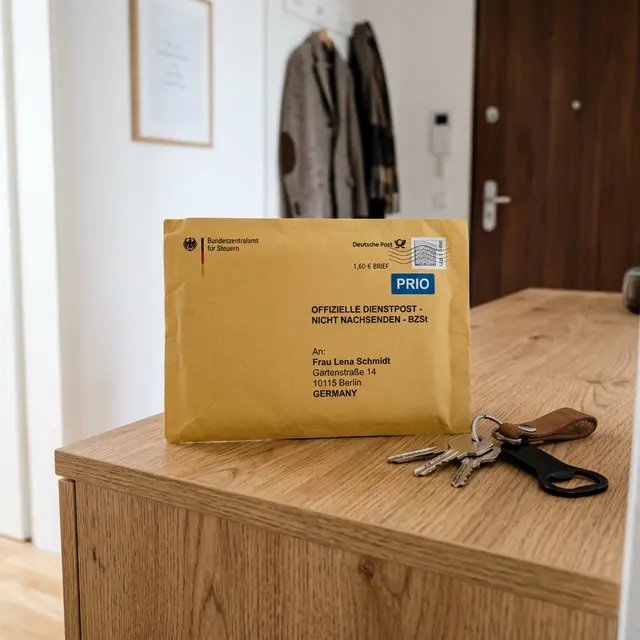
One of the first letters you receive after moving to Germany is a plain document from the Federal Central Tax Office. Inside sits your 11-digit Tax Identification Number (Steuerliche Identifikationsnummer or Steuer-ID). This number acts as the absolute key to your financial life. Without it, your employer cannot pay you correctly, you cannot open traditional bank accounts, and you cannot apply for essential benefits like Kindergeld. The system triggers automatically, but severe bureaucratic traps can delay your ID for months, causing massive temporary tax deductions. This 2026 Gold Standard guide explains exactly how to get your ID, why it differs from a Steuernummer, and a secret hack to get it in 5 days if you face a deadline.

« German bureaucracy is rigid but predictable. Treating your applications like legal documents rather than marketing flyers is the secret to getting a fast YES from any German office. »
In our 11 years guiding expats, the "missing Tax ID" panic occurs weekly. A highly paid software engineer arrives, starts a new job, but fails to provide their Steuer-ID to HR. When their first paycheck arrives, nearly 50% of their gross salary vanishes. They panic, assuming German taxes are unimaginably high.
The German tax system is deeply rigid but highly predictable. If you follow the rules, it works smoothly. Here is exactly how to secure your Steuer-ID and prevent this financial shock.
1. In Detail: What is the German Tax Identification Number?
The German Tax Identification Number (Steuer-ID, IdNr, or Identifikationsnummer) is a unique, permanent 11-digit number assigned to every person registered in Germany.
Introduced in 2007 to centralize the tax system, it replaces old, decentralized tax numbers for almost all personal state interactions.
Key Characteristics of the Steuer-ID:
- Permanent: Once issued, it never changes. It stays with you from birth (or arrival) until death. If you leave Germany for 20 years and return, you use the exact same number.
- Unique: No two people share a number. It does not tie to your birth date or region (unlike the social security number).
- Federal: The Federal Central Tax Office (Bundeszentralamt für Steuern or BZSt) in Bonn manages it, not your local city office.
- Universal: Used for income tax processing, capital gains tax on investments, and applying for social benefits like child allowance (Kindergeld).
The "Tax Class 6" Penalty: Why it is Critical
If you start a new job and fail to provide your Steuer-ID to HR by the first payroll cycle (usually the 20th), you face a harsh, automated penalty.
Without your ID, the payroll software cannot verify your marital status or child allowances. The system defaults you to Tax Class 6 (Steuerklasse VI). Under this punitive class, the government assumes this represents your second or third high-paying job and withholds the maximum amount, often nearly 50% of your gross salary. You eventually get this money back by filing a tax return the following year or updating your ID with HR in month two, but it causes a severe cash-flow crisis right when you need to pay an apartment deposit.
2. The Great Confusion: Steuer-ID vs. Steuernummer
Expats constantly mix up these two numbers, causing applications to fail. You will encounter two different tax numbers during your stay.
| Feature | Steuer-ID (Identifikationsnummer) | Steuernummer (Tax Number) | | :--- | :--- | :--- | | Format | 11 Digits (e.g., 12 345 678 901) | 10-13 Digits with slashes (e.g., 13/123/45678) | | Scope | Federal (Valid nationwide) | Local (Tied strictly to your local district Finanzamt) | | Duration | Permanent (Lifetime) | Changes automatically if you move to a new district | | Who needs it? | Everyone (Employees, Children, Retirees) | Freelancers, Businesses, and complex tax filers | | Primary Purpose | Personal tax identification & Payroll | Business tax, VAT processing, and corporate accounting |
The Freelancer Exception
If you start as a freelancer (Freiberufler) or open a business (Gewerbe), you use your Steuer-ID for personal interactions. However, you must apply for a separate Steuernummer from your local Finanzamt via the ELSTER portal to issue compliant invoices and pay VAT. You absolutely cannot use your personal Steuer-ID on a business invoice!
3. How to Obtain Your Tax ID: The Automatic Process
For most expats moving to Germany, you do not manually "apply" for a Tax ID. The system triggers itself automatically.
1. The Anmeldung (Registration)
criticalYour journey starts at the local Bürgeramt (Citizens' Office). When you register your address (Anmeldung), the official enters your data into the national population register.
2. Secure Data Synchronization
requiredThe municipal software automatically sends an encrypted data packet to the Bundeszentralamt für Steuern (BZSt) headquarters in Bonn overnight.
3. ID Generation
requiredThe federal computer checks if you exist in the database. If you have never lived in Germany, it generates a new 11-digit number.
4. Physical Mail Arrival
criticalThe federal office prints a letter and sends it via Deutsche Post to your registered address. Due to processing times, expect this 2 to 4 weeks after your Anmeldung.
In Detail: The Mailbox Trap
70% of our community members who never receive their Tax ID fall into the "Mailbox Trap."
The German postal service does not deliver mail based solely on the street address and apartment number. The postman looks specifically for the last name printed on the physical envelope. If your name is not explicitly and clearly written on your physical mailbox downstairs, the postman marks the government letter "undeliverable" and returns it to Bonn.
If staying in a temporary sublet or Airbnb, you must ensure your name is on the mailbox (e.g., tape a label saying "John Doe c/o Müller"). Failing this guarantees you will not receive your ID.
4. The "Emergency" Hack: How to get it in 5 days
If your employer's payroll cutoff approaches and you cannot wait 4 weeks for the letter from Bonn, use the "Finanzamt Shortcut."
- Wait for the Sync: Wait at least 5 full working days after your successful Anmeldung at the Bürgeramt. This ensures your data moved from the city system to the federal system.
- Locate your Finanzamt: Find your local Finanzamt (Tax Office), not the Bürgeramt. Every city district has one.
- Go in Person: Visit their "Infothek" (Information Desk) during morning hours. You usually do not need an appointment.
- Bring your Documents: Bring your valid Passport and your original Meldebescheinigung (the registration paper from the Anmeldung).
- Make the Request: Tell the officer: "Ich brauche meine Steuer-ID für meinen Arbeitgeber" (I need my Tax ID for my employer).
- Instant Printout: The officer checks your passport, looks you up in the central database, and prints a formal confirmation of your 11-digit Steuer-ID on the spot.
No Phone, No Email, No Exceptions
Due to strict German data protection laws (Datenschutz), no tax office employee will ever give you your Steuer-ID over the phone or via email. You must appear in person with your passport or wait for the physical letter.
5. Special Cases: Newborns and Living Abroad
Babies Born in Germany
If you have a child in Germany, the process is smooth. The hospital notifies the Standesamt (Registry Office), which issues the birth certificate and notifies the federal tax authorities. Your newborn receives their own Steuer-ID letter via mail within 2 to 3 weeks. You need this number immediately to apply for Kindergeld (Child Benefit), paying EUR 250 per month, per child.
Living Abroad with German Income
If you live outside Germany (e.g., USA, UK) but receive a German pension or earn rental income from a German property, you legally need a Steuer-ID. Since you cannot do an Anmeldung, you must proactively apply by contacting the Finanzamt Neubrandenburg (for pensioners abroad) or the local tax office where your property sits.
6. What is the ELStAM System?
You must understand the ELStAM system (Elektronische Lohnsteuer-Abzugsmerkmale, or Electronic Wage Tax Deduction Characteristics).
ELStAM is the highly secure digital database where the government stores factors determining your salary tax deductions.
When you give your 11-digit Steuer-ID and birth date to HR, they "log in" to ELStAM. The system does not show them your bank balance; it outputs specific tax parameters:
- Your Tax Class (Steuerklasse): (Classes 1 through 6, based on marital status).
- Church Tax Status (Kirchensteuer): (Whether you pay the 8-9% church tax).
- Child Allowances (Kinderfreibeträge): (Which slightly lowers your solidarity surcharge and church tax).
Pro-Tip for Expats: If you marry or have a child in Germany, you do not manually tell HR to change your tax class. Update your civil status at the Bürgeramt or Finanzamt. The ELStAM database updates automatically, and your employer's payroll software pulls the new, optimized data during the next cycle.
7. I lost my ID: How to recover it quickly
If you lived in Germany for years and cannot find your original BZSt letter, do not panic. You have three easy ways to find your existing number:
- Check your monthly Payslip (Gehaltsabrechnung): Look at the top header of any recent payslip. Look for "St-ID", "IdNr", or "Steuer-ID". It must be legally printed on every payslip.
- Check your Annual Tax Statement (Lohnsteuerbescheinigung): This is the crucial annual summary document your employer provides every January or February. Your ID sits prominently at the top left.
- Check your Income Tax Assessment (Steuerbescheid): If you filed a tax return previously, the official assessment letter from the Finanzamt displays your ID on the first page.
- The Online Request: If you are unemployed and lack these documents, fill out a free form on the official BZSt website. They look it up and resend the ID via physical mail to your registered address (takes 3 to 4 weeks).
Frequently Asked Questions (FAQ)
What to read next
General Information & Legal Notice
The information provided in this article is for general educational purposes only and reflects our 11+ years of experience helping expats navigate German bureaucracy. It does not constitute formal legal, tax, or professional advice.
While we strive to keep our content accurate and up-to-date, immigration laws, tax regulations, and administrative processes in Germany change frequently. We are not lawyers or registered tax advisors. For individual cases, complex legal issues, or specific tax situations, we strongly recommend consulting a qualified German lawyer (Rechtsanwalt) or a certified tax advisor (Steuerberater).
About Oliver
Founder of expats.de, former cooperative bank advisor (Bankfachwirt IHK) with 12 years of banking experience, and a §34d licensed insurance broker. Since 2014, Oliver has helped over 10,000 expats navigate the German financial system. Read Oliver's full story →
Educational Notice & General Advice
This content is educational and reflects analysis based on our 11 years of market experience, our 200,000+ community insights, and current regulatory knowledge.
As a 34d-licensed insurance broker and experienced financial advisor, I provide this guidance in good faith. However, for personalized advice especially regarding insurance, mortgages, or tax-specific decisions—please consult with a qualified financial advisor or tax professional in your specific situation. Past expat experiences and historical market data do not guarantee identical results for your unique circumstances.