
11 Years Experience
Guiding expats since 2014.
Licensed Expertise
§34d certified broker.
200K+ Community
Verified by thousands.
Expert Verified
Fact-checked.
Quick Summary
You can easily live in a major German city your entire life without owning a car. The public transportation network is dense, integrated, and safe. Germany also pioneers "free-floating" car sharing and e-scooters. However, the ticketing systems, the notorious Deutsche Bahn delays, and strict traffic rules cause massive culture shock. We watch countless newcomers get hit with EUR 60 fines simply because they didn't know they had to stamp a piece of paper. This 2026 guide explains the revolutionary 49-Euro Ticket, how to ride the U-Bahn legally, and which car-sharing apps you actually need on your phone.

« German bureaucracy is rigid but predictable. Treating your applications like legal documents rather than marketing flyers is the secret to getting a fast YES from any German office. »
1. The Local City Networks (ÖPNV): Navigating the Urban Jungle
Every German city's local public transport (Öffentlicher Personennahverkehr, or ÖPNV) operates via a regional transport association (BVG in Berlin, MVV in Munich, RMV in Frankfurt, HVV in Hamburg). Despite different app interfaces, the underlying rules remain identical nationwide.
Optimizing your transport costs represents one of the easiest ways to save money upon arrival. We see expats burning cash on single tickets daily because the subscription models overwhelm them.
The 4 Core Types of City Transport
- U-Bahn (Untergrundbahn)Source: Underground Metro (Yellow 'U' signs). The backbone of cities like Berlin, Munich, and Hamburg.easy
- S-Bahn (Stadtschnellbahn)Source: Overground Commuter Train (Green 'S' signs). Connects the city center to the deep suburbs and airports.easy
- Strassenbahn / TramSource: Streetcars. Found mostly in East German cities and Munich. Great for short distances.easy
- BusSource: Everywhere, including Night Buses (N-lines) replacing the U-Bahn after 1:00 AM on weekdays.easy
The Honor System (And the EUR 60 Trap!)
When you enter a German subway station, you find no gates or turnstiles. You just walk onto the train. It feels free. It is not.
Germany relies on an "honor system." However, never travel without a valid ticket (Schwarzfahren). Plainclothes inspectors (Kontrolleure) patrol constantly. They look like normal passengers until the doors lock, then pull a badge and yell, "Fahrkarten bitte!" (Tickets, please!).
If caught without a ticket, or an unvalidated ticket, they fine you EUR 60 on the spot. Repeated offenses lead to criminal charges for fraud (Erschleichen von Leistungen), directly threatening your visa renewal.
Validate your paper ticket (Entwerter)!
If you buy a paper ticket from a platform machine, it is usually NOT valid immediately. You MUST stamp it in the small yellow or red validation machines (Entwerter) NEXT TO the ticket machine BEFORE boarding. An unstamped ticket is legally invalid. Inspectors show zero mercy to expats. We receive emails about this EUR 60 fine weekly.
2. The Breakthrough: The Deutschlandticket (49-Euro Ticket)
The Deutschlandticket is objectively the best thing to happen to German public transport. Over 70% of our community members say it drastically improved their quality of life.
For exactly EUR 49 per month, you secure a digital subscription to use ALL local and regional public transport across the entire country.
Pros
- ✓Valid on all city buses, U-Bahns, and Trams nationwide. Never figure out local fare zones (A/B/C) again.
- ✓Valid on regional trains (RE, RB, S-Bahn) between cities (e.g., Berlin to Leipzig).
- ✓Massively cheaper than almost every single city's regular monthly pass. (A Berlin AB monthly pass used to cost EUR 86).
Cons
- ✗It is a rolling subscription (Abo), not a one-off ticket. You must actively cancel it by the 10th of the previous month.
- ✗Strictly NOT valid on high-speed long-distance trains (ICE, IC, EC) or private long-distance buses (Flixbus).
- ✗Non-transferable; it bears your name, and you must carry a photo ID.
Common Expat Mistake: The Subscription Trap
Because it is an Abonnement (subscription), you cannot "buy it for August" on August 1st and expect it to end August 31st. If you fail to cancel by the 10th, it auto-renews. Buy it through an app like Mo.pla or the BVG app, where cancellation takes one click, rather than Deutsche Bahn's clunky portal.
3. Long-Distance Travel: Deutsche Bahn & Flixbus
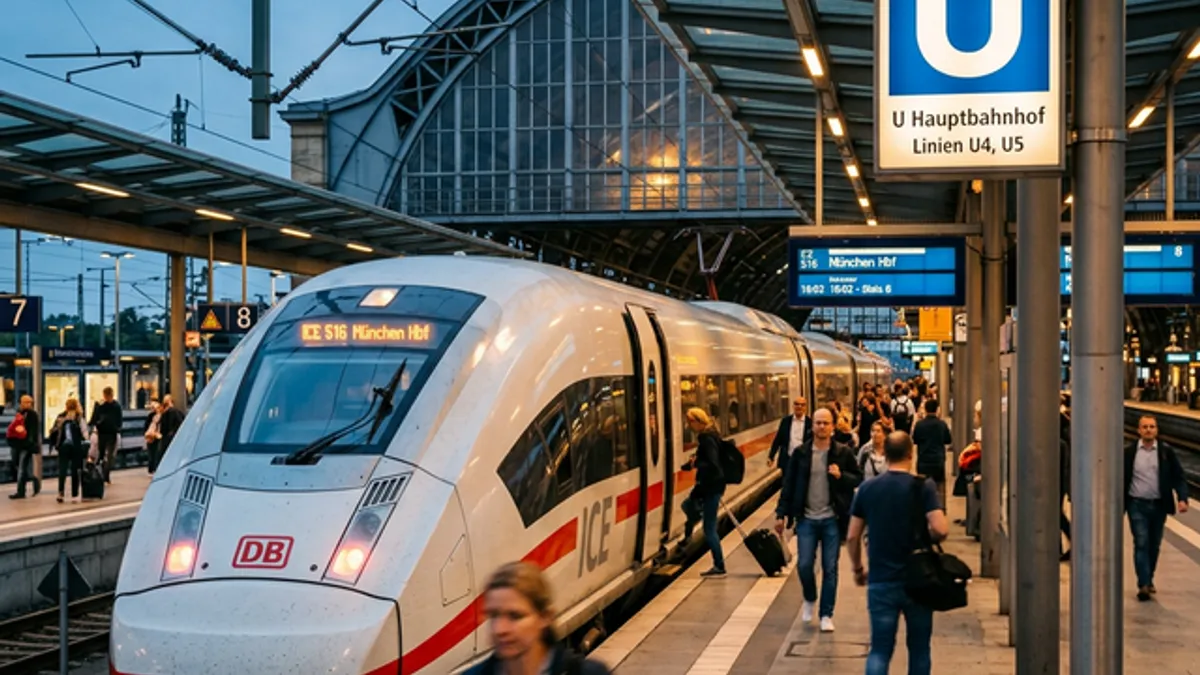
To travel fast between major hubs (Munich to Hamburg), use Deutsche Bahn (DB), the national railway. Their ICE (Intercity Express) trains travel up to 300 km/h.
Despite German engineering fame, Deutsche Bahn's punctuality is terrible. Around 35% of all long-distance trains suffer delays. Always build a massive buffer if taking a train to catch an international flight.
In Detail: How to Save Money on DB Tickets
Never buy an ICE ticket at the machine on the day of travel; it costs EUR 130 to EUR 180 one-way. Follow this community strategy:
- Sparpreis (Saver Fare): Book 2 to 6 weeks early for tickets as low as EUR 17.90. However, these bind you to that exact train (Zugbindung). Miss it, and the ticket is worthless. (If a delayed connecting DB train causes you to miss it, it becomes flexible automatically).
- Flexpreis (Flexible Fare): Expensive, but allows you to take any train on that route that day.
- The BahnCard Ecosystem: Frequent travelers must buy a BahnCard.
- BahnCard 25: Costs roughly EUR 62/year. Gives an automatic 25% discount on EVERY ticket (including Sparpreis). Pays for itself in two round trips.
- BahnCard 50: Costs roughly EUR 244/year. Gives 50% off Flexpreis, but only 25% off Sparpreis. Mostly for spontaneous business travelers.
Passenger Rights: Claiming Delay Compensation
Under EU law, force DB to pay when they fail you:
- Arrive 60+ minutes late: Claim a 25% refund.
- Arrive 120+ minutes late: Claim a 50% refund. Claim this instantly inside the DB Navigator app under "Passenger Rights" (Fahrgastrechte).
The Budget Alternative: Flixbus & Flixtrain
Flixbus dominates long-distance coach travel. Berlin to Munich takes 4 hours on ICE (EUR 80) but 8 to 9 hours on a Flixbus (EUR 15 to EUR 25). They also run Flixtrain, a budget rail alternative on select routes.
4. Car Sharing: Why Owning a Car is a Mistake
Owning a car in a German city center guarantees a parking nightmare and drains your wallet via mandatory car insurance (Kfz-Haftpflicht), vehicle tax (Kfz-Steuer), and inspections (TÜV).
The solution is Free-Floating Car Sharing.
How it works:
- Open the app, locate a parked car nearby.
- Reserve it and open it via Bluetooth.
- Drive it wherever you need.
- Park it legally within the city's "business area" (Geschäftsgebiet) and end the rental in the app.
- You pay per minute or kilometer. Fuel, parking, maintenance, and insurance are 100% included.
Top Car-Sharing Apps:
- Share Now / Free2Move: The largest fleet. Best for short inner-city trips paying by the minute.
- Miles: You pay per kilometer, not per minute. Zero stress in heavy traffic jams.
- Sixt Share: Premium cars (Audi, BMW). Unique ability to drop the car in a completely different city (for a fee).
- Cambio / Stadtmobil: "Station-based" sharing. You must return the car to its original parking spot. Cheaper for weekend trips.
Car Sharing Insurance & Deductibles
All shared cars include comprehensive insurance. However, a deductible (Selbstbeteiligung) of EUR 300 to EUR 1,000 applies if you crash. Expat Hack: Always pay the extra EUR 1 per trip in the app to reduce this deductible to EUR 0.
5. E-Scooters, Bicycles, and Taxis
E-Scooters (Tier, Lime, Voi)
E-Scooters cost around EUR 1 to start plus EUR 0.20 per minute.
CRITICAL WARNING: Police treat E-Scooters exactly like cars.
- No Sidewalks: Drive on the bike lane (Radweg). If none exists, you MUST drive on the street. Sidewalk driving triggers a heavy fine.
- Drunk Driving: The strict blood alcohol limits (0.5 per mille) apply. If you drive a scooter drunk, you lose your actual car driver's license. Do not do it.
Bicycles
Buy a cheap second-hand bike on Kleinanzeigen for EUR 50-EUR 100. Alternatively, use bike-sharing apps like Nextbike or Call a Bike.
Taxis and Uber
Taxis (cream-colored Mercedes sedans) are heavily regulated, safe, and expensive. Uber exists but operates differently. German Uber drivers must hold professional chauffeur licenses (Personenbeförderungsschein). You cannot pick up people in a private Honda Civic. Uber acts as a private hire app, often matching taxi prices. FreeNow is the popular alternative.
6. Driving Your Own Car
If you live rural and must own a car, prepare for bureaucracy.
Exchanging Your Driver's License
Non-EU/EEA foreign driver's licenses remain valid for only six months after your Anmeldung. After that, it becomes useless plastic.
- Reciprocity Agreements: Citizens of the UK, Canada, Australia, Japan, or certain US states (Texas) simply exchange their license for a German one at the Fahrerlaubnisbehörde (approx. EUR 35).
- No Agreement: Citizens of India, South Africa, or California must pass both the German theoretical and practical driving tests (costs EUR 1,000+ and takes months).
The Autobahn Rules
While sections lack speed limits (Richtgeschwindigkeit is 130 km/h), rules are rigidly enforced:
- Rechtsfahrgebot: You MUST drive in the right lane unless overtaking. Cruising in the middle or left lane is illegal.
- No Passing on the Right: Never overtake a car on its right side.
- Emergency Lane (Rettungsgasse): In a traffic jam, the left lane pulls far left; all other lanes pull far right. This creates a center lane for ambulances. Failing to form a Rettungsgasse results in massive fines and license points.
Frequently Asked Questions (FAQ)
General Information & Legal Notice
The information provided in this article is for general educational purposes only and reflects our 11+ years of experience helping expats navigate German bureaucracy. It does not constitute formal legal, tax, or professional advice.
While we strive to keep our content accurate and up-to-date, immigration laws, tax regulations, and administrative processes in Germany change frequently. We are not lawyers or registered tax advisors. For individual cases, complex legal issues, or specific tax situations, we strongly recommend consulting a qualified German lawyer (Rechtsanwalt) or a certified tax advisor (Steuerberater).
About Oliver
Founder of expats.de, former cooperative bank advisor (Bankfachwirt IHK) with 12 years of banking experience, and a §34d licensed insurance broker. Since 2014, Oliver has helped over 10,000 expats navigate the German financial system. Read Oliver's full story →
Educational Notice & General Advice
This content is educational and reflects analysis based on our 11 years of market experience, our 200,000+ community insights, and current regulatory knowledge.
As a 34d-licensed insurance broker and experienced financial advisor, I provide this guidance in good faith. However, for personalized advice especially regarding insurance, mortgages, or tax-specific decisions—please consult with a qualified financial advisor or tax professional in your specific situation. Past expat experiences and historical market data do not guarantee identical results for your unique circumstances.