
11 Years Experience
Guiding expats since 2014.
Licensed Expertise
§34d certified broker.
200K+ Community
Verified by thousands.
Expert Verified
Fact-checked.
Quick Summary
Your first German payslip delivers a shock: nearly 20% of your gross salary vanishes into social security before income taxes apply. Do not view this as a pure tax. It provides a world-class safety net protecting you from catastrophic illness, nursing care needs, and sudden job loss. This 2026 guide explains the 5 mandatory pillars, exactly who pays what, the hidden employer match, and how to obtain your Social Security Number (Sozialversicherungsnummer).

« German bureaucracy is rigid but predictable. Treating your applications like legal documents rather than marketing flyers is the secret to getting a fast YES from any German office. »
1. What is the German Social Security System?
The German social security system (Sozialversicherungssystem) is a statutory, state-mandated insurance system built on solidarity: the young pay for the old, the healthy pay for the sick, and the employed support the unemployed.
It protects residents from severe financial risks: catastrophic illness, nursing care needs, workplace accidents, old age poverty, and sudden unemployment.
If you are legally employed and earn more than EUR 556 per month (the 2026 "Minijob" limit), participation is mandatory. You cannot opt out to invest in the stock market (except high earners choosing private health insurance).
The Hidden Benefit: The 50/50 Split Rule
Expats often fixate on the massive deductions. They miss the shared burden.
Contributions split equally, roughly 50/50, between employee and employer. A 9.3% pension deduction means your employer secretly pays another 9.3% directly to the government. This represents a massive hidden boost to your actual compensation.
2. The Five Pillars of Social Insurance
The system utilizes five core pillars. HR automatically registers you and deducts the correct percentages via payroll software.
1. Health Insurance (Krankenversicherung - KV)
criticalWhat it covers: Unlimited medical treatments, hospital stays, prescription drugs, surgeries, and sick pay (Krankengeld) after 6 weeks of illness.
Cost: Currently 14.6% of your gross salary, plus an additional contribution (Zusatzbeitrag) averaging 1.7%.
Who Pays: Split exactly 50/50. Mandatory for everyone, though high earners (above EUR 69,300) can opt for private health insurance (PKV).
2. Pension Insurance (Rentenversicherung - RV)
requiredWhat it covers: A monthly pension at legal retirement age (67). Pays disability pensions if you cannot work, and survivor pensions.
Cost: 18.6% of your gross salary.
Who Pays: Split exactly 50/50 (you pay 9.3%, employer pays 9.3%).
3. Unemployment Insurance (Arbeitslosenversicherung - AV)
requiredWhat it covers: Temporary income replacement (Arbeitslosengeld I), usually 60% of your net pay (67% with children). Available for up to 12 months if you paid in for 12 of the last 30 months.
Cost: 2.6% of your gross salary.
Who Pays: Split exactly 50/50 (1.3% each).
4. Nursing Care Insurance (Pflegeversicherung - PV)
requiredWhat it covers: Financial support if you become permanently dependent on nursing care due to old age or illness. Prevents financial ruin from long-term care costs.
Cost: Around 3.4% of your gross salary.
The Childless Surcharge: A 0.6% surcharge applies if over 23 without children. Split roughly 50/50 with the employer (you pay the childless surcharge entirely).
5. Accident Insurance (Unfallversicherung - UV)
requiredWhat it covers: Medical costs and disability pensions resulting strictly from workplace accidents or direct commutes.
Cost: Variable by industry risk.
Who Pays: Paid 100% by your employer. You pay nothing.
3. Your Social Security Number (SV-Nummer)
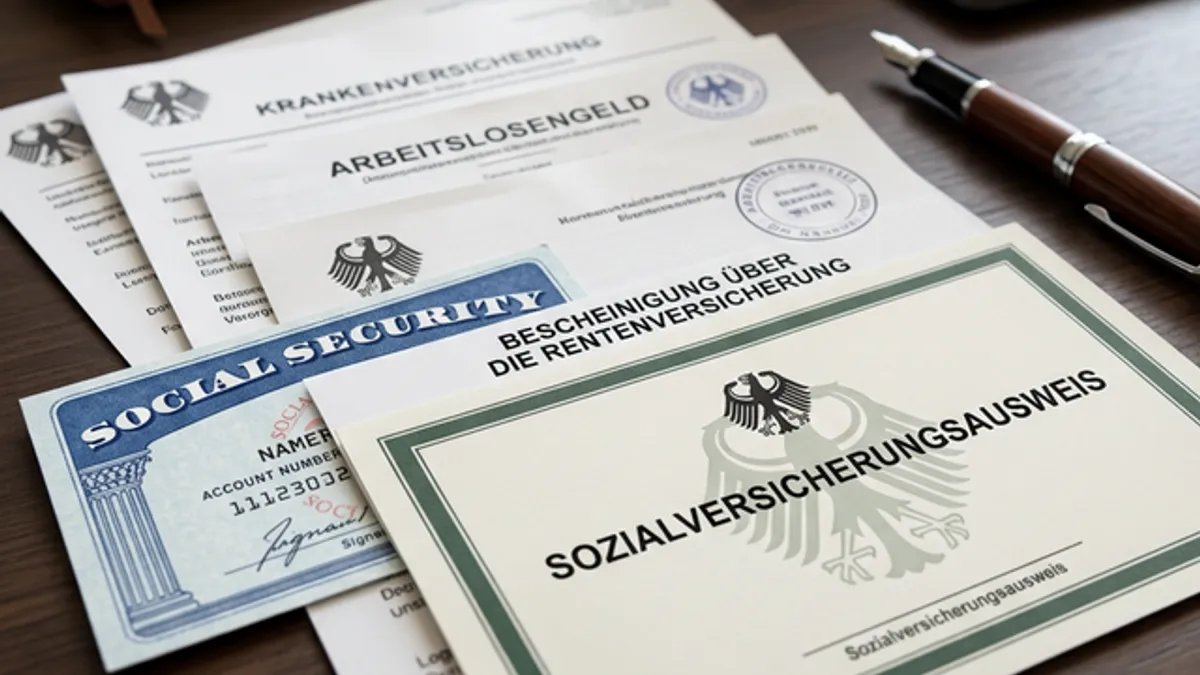
Your Social Security Number (Sozialversicherungsnummer or RV-Nummer) is a unique 12-digit alphanumeric code. You keep this number your entire life in Germany.
Format: 12 230992 M 123
- 12: Area code
- 230992: Date of birth (DDMMYY)
- M: Initial of birth surname
- 123: Serial/Gender digits
You need this number for employment contracts, unemployment welfare, or pension refunds.
How to obtain your number as an Expat
-
The Automatic Way (Highly Recommended): Sign up for statutory (public) health insurance (TK, Barmer). They automatically trigger the application. The official letter from the Deutsche Rentenversicherung arrives in 4 to 6 weeks.
-
Via Your Employer's HR: If you start work immediately, your employer's HR department triggers the application via their DATEV payroll software.
-
The Direct, Manual Route: Freelancers or job seekers can visit a local Deutsche Rentenversicherung or Krankenkasse branch. Bring your passport and Anmeldebestätigung. They generate the number instantly.
Real-Life Hack: Lost your Number?
If you threw away the original letter, do not panic. Call your public health insurance provider's hotline. They store your SV-Nummer permanently. After verifying your identity, they supply it over the phone.
4. In Detail: Getting Your Pension Money Back
If you are a highly skilled expat returning home, you can often claim a massive lump sum refund of your 9.3% pension deductions.
To qualify for a full refund of your employee contributions:
- Nationality: You must be a non-EU/EEA citizen (USA, India, Australia, UK).
- Time Limit: You must have paid into the German pension system for less than 60 months (5 years). Hitting 60 months vests you in the system, preventing a refund.
- Departure: You must completely leave the European Union.
- Waiting Period: Wait exactly 24 months after your last contribution before submitting form V0901.
A software engineer working 4 years can claim EUR 25,000 to EUR 35,000 directly to their foreign bank account. Use a specialized service to handle the complex paperwork.
5. What Happens if I Become Unemployed?
Understanding Pillar 3 (Unemployment Insurance) reduces anxiety.
If fired during or after your probation period, you remain protected.
Step-by-Step Action Plan:
- Register as a Jobseeker: The day you receive termination, register online as "jobseeking" (arbeitssuchend) with the Agentur für Arbeit. Delaying this risks a 12-week blocking period.
- Register as Unemployed: On your first day without a job, register as "unemployed" (arbeitslos).
- Receive Your Money: If you paid social security for 12 of the last 30 months, you receive Arbeitslosengeld I (ALG I), 60% of your net salary (67% with children) for up to 12 months.
- Health Insurance Continues: The Agentur für Arbeit automatically pays your monthly health insurance and pension contributions while you receive ALG I.
Quitting Your Job Voluntarily
If you resign voluntarily without a medical reason or new job, the Agentur für Arbeit imposes a 12-week blocking period (Sperrzeit). You receive EUR 0 for 3 months and must pay your own health insurance (approx. EUR 220/month). Never quit without a backup plan.
Frequently Asked Questions (FAQ)
What to read next
General Information & Legal Notice
The information provided in this article is for general educational purposes only and reflects our 11+ years of experience helping expats navigate German bureaucracy. It does not constitute formal legal, tax, or professional advice.
While we strive to keep our content accurate and up-to-date, immigration laws, tax regulations, and administrative processes in Germany change frequently. We are not lawyers or registered tax advisors. For individual cases, complex legal issues, or specific tax situations, we strongly recommend consulting a qualified German lawyer (Rechtsanwalt) or a certified tax advisor (Steuerberater).
About Oliver
Founder of expats.de, former cooperative bank advisor (Bankfachwirt IHK) with 12 years of banking experience, and a §34d licensed insurance broker. Since 2014, Oliver has helped over 10,000 expats navigate the German financial system. Read Oliver's full story →
Educational Notice & General Advice
This content is educational and reflects analysis based on our 11 years of market experience, our 200,000+ community insights, and current regulatory knowledge.
As a 34d-licensed insurance broker and experienced financial advisor, I provide this guidance in good faith. However, for personalized advice especially regarding insurance, mortgages, or tax-specific decisions—please consult with a qualified financial advisor or tax professional in your specific situation. Past expat experiences and historical market data do not guarantee identical results for your unique circumstances.