
11 Years Experience
Guiding expats since 2014.
Licensed Expertise
§34d certified broker.
200K+ Community
Verified by thousands.
Expert Verified
Fact-checked.
Quick Summary
Entering Germany requires adhering to strict visa regulations tied directly to your passport and qualifications. While EU citizens enjoy freedom of movement, third-country nationals must secure the correct residence permit. From the EU Blue Card's newly lowered salary thresholds to the Opportunity Card (Chancenkarte) and the Freelance Visa, this 2026 guide details the exact paths to legally work in Germany.
1. Visa vs. Residence Permit: The Critical Distinction
Misunderstanding this fundamental distinction causes border rejections and deportations.
- Visa (Visum): Issued by a German Embassy in your home country before you travel. Valid for 90 days (Type C) or up to 6 months (Type D). It allows legal entry.
- Residence Permit (Aufenthaltstitel): Issued by the Foreigners' Office (Ausländerbehörde) inside Germany after arrival. This plastic card allows you to stay and defines your working rights.

"Expats frequently enter on a 90-day Schengen Tourist Visa, assuming they can 'upgrade' it to a work visa once they find a job. You cannot. The Ausländerbehörde rejects the application and deports you to apply properly. Always apply for a National Visa (Type D) for long-term stays."
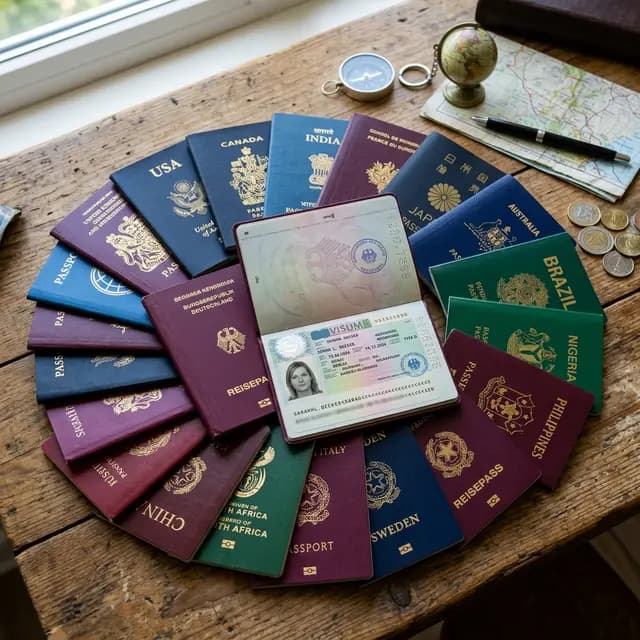
2. Your Passport Decides Your Path
The bureaucratic hurdles depend entirely on your nationality.
Group 1: EU, EEA, and Swiss Citizens
You hold Freedom of Movement (Freizügigkeit). No visa required. Register your address (Anmeldung) within 14 days and start working immediately.
Group 2: The Privileged Nations
Australia, Canada, Israel, Japan, New Zealand, South Korea, UK, USA. Enter Germany visa-free for 90 days. Apply for the residence permit directly at the Ausländerbehörde inside Germany. You absolutely cannot work until receiving the physical permit.
Group 3: Third-Country Nationals
India, Brazil, Turkey, China, etc. You must apply for a National Visa (Type D) at the German embassy in your home country before flying. You cannot enter as a tourist and convert your status.
3. The Big Three: Employment Visas
1. The EU Blue Card (Blaue Karte EU)
criticalTarget: Highly skilled academics and IT professionals. Requirements (2026): Recognized university degree (or 3 years IT experience), a binding job offer, and a salary above EUR 45,300 (or EUR 41,041 for shortage occupations like IT, engineering). The Perks: Fast-track permanent residency in 21-33 months. Immediate, unrestricted work rights for your spouse without A1 German requirements.
2. Skilled Worker Visa (Fachkraft)
requiredTarget: Professionals with recognized vocational training or degrees missing the Blue Card threshold. Requirements: Official German recognition of your foreign qualification (Anerkennungsverfahren) and a binding job offer.
3. IT Specialist Visa
optionalTarget: IT professionals lacking a university degree. Requirements: 3 years of professional IT experience, a gross salary of at least EUR 40,770 (2026), and B1 German (often waived for English-speaking roles).
4. The Freelance Visa: Freiberufler vs. Gewerbe
Germany'strictly divides self-employment.
Freiberufler (Liberal Professions)
Artists, doctors, lawyers, consultants, IT developers. Requires:
- Two letters of intent (Absichtserklärungen) from German clients.
- Financial stability proof.
- Easier process, no trade tax.
Gewerbe (Commercial Business)
E-commerce, shops, agencies. High barrier to entry. Requires:
- A comprehensive business plan fulfilling a "regional need."
- Trade registration and Trade Tax (Gewerbesteuer) liability.
Common Expat Mistake: Applying as a Freiberufler while operating a Gewerbe. The tax office (Finanzamt) will demand massive retroactive trade taxes.
5. The Stepping Stone Visas
The Opportunity Card (Chancenkarte)
A points-based system allowing qualified professionals to enter Germany for 1 year to hunt for a job.
- Requirements: 6 points (degree, language, experience).
- Perks: Work part-time (20 hours/week) while searching.
- Financials: Requires a EUR 12,000 Blocked Account.
The Student Visa
Offers access to nearly free university education. Requires university admission and a Blocked Account.
- Perks: Work 140 full days/year.
- After Graduation: Secures an 18-month Job Seeker extension, transitioning easily into a Blue Card.
Vocational Training Visa (Ausbildung)
Combines practical company work with classroom learning for trades (nursing, IT). Earn a modest salary during training.
6. Family Reunion Visa (Ehegattennachzug)
Bring your spouse and minor children.
Unless you hold an EU Blue Card or ICT Visa, your spouse generally must prove A1 German language skills before securing the entry visa. You must also prove sufficient housing space (12sqm per person).
7. Financial and Insurance Requirements
The Blocked Account (Sperrkonto)
Required for students and job seekers. Deposit roughly EUR 12,000. Withdraw exactly EUR 1,000 monthly to prove self-sufficiency.
Health Insurance: A Non-Negotiable Requirement
You will not get a visa without health insurance.
- Incoming Insurance: Requires specialized travel insurance covering from day one.
- Employed: Earn under EUR 77,400? Join the public system (TK, Barmer). Earn above? Opt for private insurance (PKV).
8. Navigating the Ausländerbehörde
Getting the physical appointment in Berlin or Munich causes severe delays.
Pro Tips:
- The 6 AM Rule: Refresh appointment portals between 6:00 AM and 8:00 AM.
- Fast-Track Procedure: Employers use Beschleunigtes Fachkräfteverfahren (EUR 411 fee) to bypass normal queues.
- Fiktionsbescheinigung: If your visa expires, email your renewal application before expiration. This automatically extends your legal stay until processed. Keep the email printout.
9. Permanent Residency and Naturalization
Permanent Residency (Niederlassungserlaubnis)
- Standard Timeline: 60 months (5 years) of pension contributions and B1 German.
- Blue Card Fast-Track: 33 months (A1 German) or 21 months (B1 German).
- Graduates: 24 months of working in a degree-related job.
The New 2026 Citizenship Laws (Einbürgerung)
Dual citizenship is now universally allowed.
- Standard Route: Apply after 5 years with B1 German.
- Exceptional Integration: Apply after 3 years with C1 German and outstanding achievements.
Frequently Asked Questions (FAQ)
What to read next
General Information & Legal Notice
The information provided in this article is for general educational purposes only and reflects our 11+ years of experience helping expats navigate German bureaucracy. It does not constitute formal legal, tax, or professional advice.
While we strive to keep our content accurate and up-to-date, immigration laws, tax regulations, and administrative processes in Germany change frequently. We are not lawyers or registered tax advisors. For individual cases, complex legal issues, or specific tax situations, we strongly recommend consulting a qualified German lawyer (Rechtsanwalt) or a certified tax advisor (Steuerberater).
About Oliver
Founder of expats.de, former cooperative bank advisor (Bankfachwirt IHK) with 12 years of banking experience, and a §34d licensed insurance broker. Since 2014, Oliver has helped over 10,000 expats navigate the German financial system. Read Oliver's full story →
Educational Notice & General Advice
This content is educational and reflects analysis based on our 11 years of market experience, our 200,000+ community insights, and current regulatory knowledge.
As a 34d-licensed insurance broker and experienced financial advisor, I provide this guidance in good faith. However, for personalized advice especially regarding insurance, mortgages, or tax-specific decisions—please consult with a qualified financial advisor or tax professional in your specific situation. Past expat experiences and historical market data do not guarantee identical results for your unique circumstances.