
11 Years Experience
Guiding expats since 2014.
Licensed Expertise
§34d certified broker.
200K+ Community
Verified by thousands.
Expert Verified
Fact-checked.
Quick Summary
When renting an apartment in Germany, the space often comes completely empty, down to the bare lightbulbs and lack of a kitchen. By the time you install a fitted kitchen, buy a sofa, and set up your electronics, you easily house EUR 15,000 to EUR 30,000 worth of personal property. Household Contents Insurance (Hausratversicherung) acts as the financial safety net protecting these assets. A single burst pipe or a stolen EUR 3,000 e-bike can'trigger catastrophic financial loss. Crucially, your landlord's insurance covers the physical building, never your personal belongings. This 2026 guide explains how to calculate your sum insured, what "gross negligence" means, and which digital providers offer the best English-language protection.

« Forget every other insurance until you have Personal Liability (Privathaftpflicht). In Germany, you are liable with your future income if you accidentally injure someone. It is the best 5 Euros you will ever spend. »
1. In Detail: What exactly is Hausratversicherung?
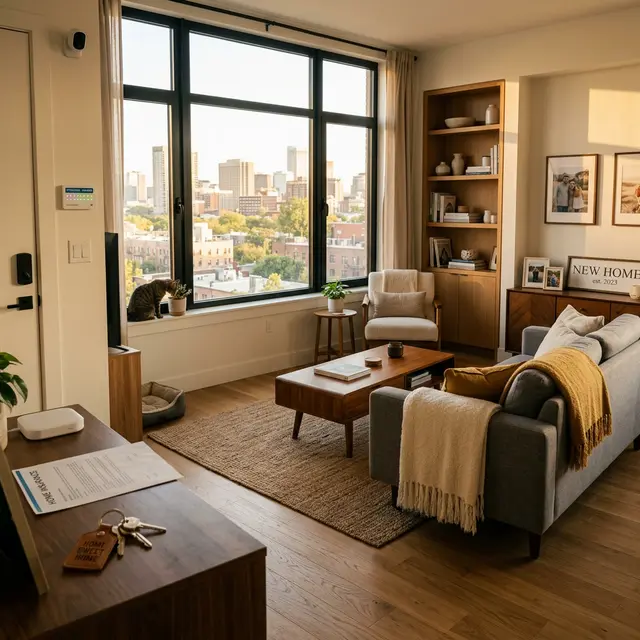
In the German insurance industry, we use a simple visual rule: If you could pick your apartment up, turn it upside down, and shake it, everything that falls out is your "Hausrat" (Household Contents).
Almost 75% of German households hold a Hausratversicherung. Locals consider it a fundamental "no-brainer" because it costs mere euros (often EUR 3 to EUR 10 a month) but shields you from total financial ruin.
What standard policies COVER:
- Fire, Lightning & Explosion: Total loss from a kitchen fire or smoke damage from a neighboring flat.
- Tap Water Damage (Leitungswasser): Ruined wooden floors, swollen furniture, or destroyed electronics caused by a burst pipe, leaking washing machine, or broken dishwasher.
- Burglary & Vandalism (Einbruchdiebstahl): Theft from your locked apartment or locked basement cellar (Keller). It also covers repairing the smashed door or window.
- Storm & Hail (Sturm/Hagel): Damage to items if a severe storm (wind force 8 or higher) shatters a window and destroys your living room.
What standard policies DO NOT COVER:
- The Building Structure: Physical walls, fixed plumbing, and standard windows belong to the landlord and fall under their Wohngebäudeversicherung.
- Simple Theft (Einfacher Diebstahl): Leaving your laptop on a park bench or your phone at a cafe table. Hausrat only covers "Burglary" (breaking into a locked room).
- Accidental Damage by You: Tripping over a rug and dropping your EUR 1,000 iPhone requires a specialized "All-Risk" or "Handyversicherung" add-on.
- Damage to OTHER People's Stuff: If your washing machine leaks and ruins your neighbor's ceiling, Hausrat covers your ruined rug, but your Privathaftpflicht (Personal Liability Insurance) pays for the neighbor's ceiling. You must hold both policies.
2. The Expat Critical Add-on: Bicycle Theft
In major German cities (Berlin, Munich, Leipzig), bicycle theft is rampant. High-quality bicycles and expensive e-bikes represent prime targets. A modern Hausrat policy provides immense value here.
The "Outside" Trap: A standard, cheap household policy only covers your bicycle if thieves steal it from inside your locked apartment or your locked private cellar. If you lock your bike to a lamppost outside your office and it disappears during the day, standard Hausrat pays you exactly EUR 0.
The 2026 Solution: Modern digital providers (GetSafe, Feather) allow you to add a specific Fahrraddiebstahl (Bicycle Theft) module to your Hausrat policy for a few extra euros monthly.
- It covers your bike 24/7, day and night, anywhere in Germany (and often across Europe).
- You must secure your bike with an appropriate lock to a fixed object (bike rack, fence, heavy lamppost). Locking the wheel to the frame is insufficient.
- Ensure the "Sum Insured" for the bike module matches its value. A EUR 3,000 e-bike requires a EUR 3,000 bike coverage limit.
Keep Your Receipts!
If thieves steal your bike, the insurance company demands proof of ownership. You must provide the original purchase receipt for the bike (showing the frame number) AND the receipt for the heavy-duty bike lock. Insurers usually require a lock with a minimum purchase price of EUR 50 or a specific security rating (ABUS Level 10+). Save these receipts!
3. How to avoid "Under-Insurance" (Unterversicherung)
Falling into the "under-insured" trap is a critical expat mistake.
When signing up, you state the total replacement value of all your belongings. If you estimate EUR 25,000, you set your limit to EUR 25,000. Over the years, you buy a MacBook, a 4K TV, and designer clothes. Your actual belongings are now worth EUR 50,000.
If your flat burns down, you might assume the insurance will pay the EUR 25,000 maximum. Wrong.
Because you insured only half your total value (EUR 25k of EUR 50k), the insurance company deems you 50% under-insured. They legally pay only 50% of ANY claim. If a burst pipe ruins a EUR 2,000 sofa, they pay you EUR 1,000.
The "Square Meter Rule" (The Easy Way Out)
To bypass this penalty, almost all German insurers offer a flat-rate calculation based on apartment size: usually EUR 650 per square meter.
- A 60 sqm flat automatically sets the sum insured to EUR 39,000 (60 x 650).
- The Massive Perk: Using this standard method legally includes an "Unterversicherungsverzicht" (Waiver of Under-Insurance). The insurer promises never to check if you actually owned more. They pay the full replacement value of any damaged item up to the EUR 39,000 limit, no questions asked.
Always use the square meter rule.
4. In Detail: "Grobe Fahrlässigkeit" (Gross Negligence)
This distinctly German legal concept catches foreigners off guard.
"Gross negligence" means you acted incredibly irresponsibly, facilitating the damage.
- Example 1: Leaving a candle burning on your table while you go to the supermarket.
- Example 2: Leaving your ground-floor window wide open, locking the front door, and going to work.
- Example 3: Starting your washing machine and leaving for a two-week vacation.
Historically, proving "Grobe Fahrlässigkeit" allowed insurance companies to legally refuse your claim entirely.
Today, you must ensure your Hausrat policy explicitly includes "Verzicht auf die Einrede der groben Fahrlässigkeit" (Waiver of the objection of gross negligence). With this clause, the insurer pays even if you made a stupid mistake like leaving the window tilted. The modern providers we recommend include this by default.
5. Best Digital Providers for Expats in 2026
Do not use traditional insurers (Allianz, AXA) for Hausrat. Their contracts are strictly in German, lack flexibility, and require physical mail cancellation 3 months before year-end. We recommend these digital-first neo-insurers.
Why GetSafe wins for Hausrat:
GetSafe offers immense modularity. Start with a cheap base policy. Buy an expensive e-bike next month? Toggle the bike module "on" in the app. Move from a 40 sqm to an 80 sqm flat? Update the number in the app; your premium adjusts instantly. Best of all, cancel daily, avoiding multi-year German contract traps.
6. Real-Life Scenarios: Will it Pay?
Scenario A: The Basement Break-In Marcus stores winter tires and power tools in his assigned basement room (Keller), secured with a heavy padlock. A thief breaks the padlock and steals the tools.
- The Verdict: Paid. Because the cellar was locked and explicitly belongs to his apartment, this counts as "Einbruchdiebstahl" (Burglary).
Scenario B: The Clumsy Laptop Drop Sarah trips over her laptop charging cable in her home office, shattering her EUR 2,000 MacBook screen.
- The Verdict: NOT Paid. Standard Hausrat covers external events (fire, theft), not personal clumsiness. She needs specific electronics insurance or an all-risk extension.
Scenario C: The Burst Pipe Disaster David is at work when a pipe bursts inside his bathroom wall. Water ruins his custom wooden wardrobe, rug, and PlayStation.
- The Verdict: Paid. Hausratversicherung covers the replacement cost (Neuwert) of the wardrobe, rug, and PlayStation. (The landlord's insurance covers fixing the pipe and drying the floors).
Frequently Asked Questions (FAQ)
What to read next
General Information & Legal Notice
The information provided in this article is for general educational purposes only and reflects our 11+ years of experience helping expats navigate German bureaucracy. It does not constitute formal legal, tax, or professional advice.
While we strive to keep our content accurate and up-to-date, immigration laws, tax regulations, and administrative processes in Germany change frequently. We are not lawyers or registered tax advisors. For individual cases, complex legal issues, or specific tax situations, we strongly recommend consulting a qualified German lawyer (Rechtsanwalt) or a certified tax advisor (Steuerberater).
About Oliver
Founder of expats.de, former cooperative bank advisor (Bankfachwirt IHK) with 12 years of banking experience, and a §34d licensed insurance broker. Since 2014, Oliver has helped over 10,000 expats navigate the German financial system. Read Oliver's full story →
Educational Notice & General Advice
This content is educational and reflects analysis based on our 11 years of market experience, our 200,000+ community insights, and current regulatory knowledge.
As a 34d-licensed insurance broker and experienced financial advisor, I provide this guidance in good faith. However, for personalized advice especially regarding insurance, mortgages, or tax-specific decisions—please consult with a qualified financial advisor or tax professional in your specific situation. Past expat experiences and historical market data do not guarantee identical results for your unique circumstances.