
11 Years Experience
Guiding expats since 2014.
Licensed Expertise
§34d certified broker.
200K+ Community
Verified by thousands.
Expert Verified
Fact-checked.
Quick Summary
Germany operates on a culture of automatically renewing, long-term contracts. If you simply stop paying your internet, gym, or apartment rent without formally canceling, you will face aggressive debt collection agencies. Thankfully, the "Fair Consumer Contracts Act" drastically improved your rights. Over our 11 years guiding expats, we have helped thousands escape predatory auto-renewals. Here is the exact 2026 legal framework to legally break your German contracts, including how to properly resign from your job without losing your rights or destroying your credit'score.
Table of Contents
The New 2026 Consumer Protection Laws

"Historically, German companies trapped expats in predatory 24-month contracts that automatically renewed for another 12 months if you missed a tiny cancellation window. The government changed the law. In 2026, the 'Fair Consumer Contracts Act' strictly outlaws automatic 12-month extensions for gym and internet contracts. However, housing and employment contracts remain extremely rigid. Follow this guide to protect your Schufa score and bank balance."
The 2022 "Fair Consumer Contracts Act" (Gesetz für faire Verbraucherverträge) fundamentally changed consumer subscriptions in Germany. It leveled the playing field against telecommunication providers and fitness chains.
- The Old Law: If you missed canceling a 2-year gym contract exactly 3 months before it ended, it renewed for an entire year. You paid 12 months for an unwanted service.
- The New Law (2026): Once your initial contract period (usually 12 or 24 months) expires, the contract automatically converts into a rolling monthly contract. You can cancel it at any time with a 1-month notice period.
In Detail: The 1-Month Rolling Rule
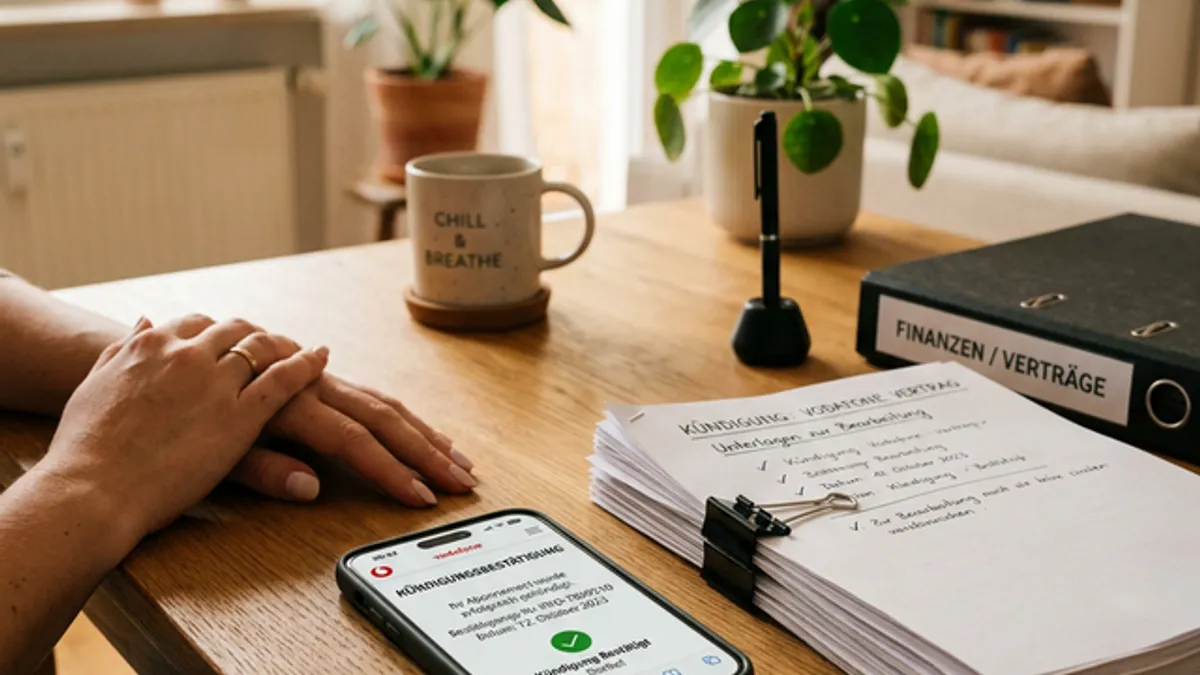
Over 70% of our community members report paying cancellation services unnecessary fees because they did not know this rule. If you signed a Vodafone internet contract in January 2023 for 24 months, the fixed term ended in January 2025. You now hold a rolling contract. If you cancel today, your contract ends exactly one month from today. You owe them nothing more.
1. Resigning from your Job (Arbeitsvertrag)
Whether you switch employers, move to a different city, or start a freelance business, you must formally resign. The German labor market is strictly regulated. Skipping a step triggers serious legal and financial consequences.
The "Wet Ink" Rule (§ 623 BGB)
Under German civil law, you cannot resign via email, WhatsApp, Slack, or digital signature (DocuSign). A resignation letter (Kündigungsschreiben) requires a physical piece of paper with your original, handwritten signature ("wet ink"). An email to HR renders your resignation legally void. Your notice period does not tick until HR holds the physical paper.
- Common Expat Mistake: John, an engineer, sent an email resignation on the 30th of the month. HR informed him two weeks later they needed a physical letter. Because he missed the end-of-month deadline, his start date at his new job delayed by an entire month.
Notice Periods (Kündigungsfrist)
Check your employment contract. Notice periods are sacred in Germany.
- During Probation (Probezeit): During the first 6 months, you usually resign with a 2-week notice period, ending on any day.
- After Probation: The statutory minimum is 4 weeks, taking effect on the 15th or the end of a calendar month. However, modern tech contracts and senior roles frequently demand a 3-month notice period to the end of the month ("3 Monate zum Monatsende").
1. Write the Letter
criticalKeep it'strictly professional. State clearly: "Hiermit kündige ich meinen Arbeitsvertrag ordentlich und fristgerecht zum [Date]." (I hereby resign from my employment contract in due time as of [Date]). You do not need to give a reason or list where you are going.
2. Hand it over physically
requiredHand the physical letter to HR or your boss in person. Ask them to sign a copy as proof of receipt ("Empfangsbestätigung"). If you work remotely, send it via registered mail (Einwurf Einschreiben).
3. Request your Arbeitszeugnis
requiredBy law, you are entitled to a qualified letter of reference (Qualifiziertes Arbeitszeugnis). This is crucial for your German career, as it contains a coded evaluation of your performance. Request this explicitly in your letter.
Use our Free Generator
Do not know how to write the letter? Use our free Cancellation Letter Generator to instantly create a legally binding PDF.
2. Canceling your Apartment (Mietvertrag)
Your apartment acts as your biggest financial liability. German tenancy law heavily protects renters from eviction, but it enforces strict notice periods to protect landlords.
The Rigid 3-Month Rule
By law (§ 573c BGB), you must give your landlord exactly 3 months' notice. The cancellation must reach the landlord by the 3rd working day of the month to count for that month. (Example: If you want to move out on November 30th, the landlord must hold your signed cancellation letter no later than September 3rd).
This must be a physical letter with a wet ink signature. An email to your property manager (Hausverwaltung) holds zero legal weight. If two main tenants appear on the lease, both must sign the letter.
The "Nachmieter" Myth
Many expats arrive believing: "If I find a replacement tenant (Nachmieter), I can break the 3-month rule and leave immediately." This is false.
Unless your contract explicitly contains a "Nachmieterklausel" (Replacement Tenant Clause), extremely rare in modern contracts, the landlord holds no legal obligation to accept your replacement. They can force you to pay the full 3 months even if the apartment sits empty. Always negotiate amicably. Aggressive emails demanding they accept a Nachmieter result in the landlord enforcing the full period out of spite.
Real-Life Scenario: The Overlapping Rent Trap
Maria found her dream apartment in Berlin, available immediately. Bound by the 3-month notice period on her old apartment, she paid "Doppelmiete" (double rent) for three months. To avoid this, some tenants sign a cancellation agreement (Aufhebungsvertrag) with their landlord. Landlords usually agree only if they want to renovate or significantly raise the rent for the next tenant.
3. Internet, Phones & Gyms
These contracts used to trap expats. Today, the process is simpler if you know your rights.
The "Kündigungsbutton" (Cancellation Button Law)
Since July 2022, any company selling online subscriptions (McFit, Netflix, O2) must legally provide an easy-to-find "Cancellation Button" (Kündigungsbutton) on their website. You no longer send registered mail or hunt for fax numbers to cancel your internet. Click the button or fill out a digital form. If a company fails to provide this button, consumers gain the right to cancel immediately without notice.
What if I'm stuck in a 24-month contract?
If you hit month 6 of a 24-month contract with Telekom, you legally owe the remaining 18 months. However, a major exception exists: Relocating. If you move to a new German apartment where your internet provider cannot deliver the agreed-upon speed, you hold a Sonderkündigungsrecht (Special Cancellation Right) with a 1-month notice period. For example, if you paid for 1,000 Mbit/s fiber but your new building only supports 50 Mbit/s DSL, break the contract.
If you leave Germany entirely (Abmeldung), you hold the right to cancel all long-term contracts (gym, internet, phone) with a strict 1-month notice period, regardless of the remaining months. (Read our dedicated "Leaving Germany" cancellation guide for exact steps).
The Auto-Renewal Trap
The new law stopping automatic 12-month renewals only applies to contracts signed after March 1, 2022. If you hold an ancient 2018 contract that simply rolled over, it might fall under the old, predatory rules. Check your provider's portal immediately.
4. Insurance Policies (Versicherungen)
Insurance contracts follow slightly different rules than consumer subscriptions.
- Health Insurance (Krankenversicherung): In the public system (TK, AOK, Barmer), you face a standard binding period of 12 months. Afterward, you switch providers with a 2-month notice period. If your provider raises their supplementary contribution rate (Zusatzbeitrag), you gain a special right of termination (Sonderkündigungsrecht) and switch immediately.
- Liability & Contents Insurance (Haftpflicht & Hausrat): These run for 1 year. You must cancel them 3 months before the end of the insurance year, or they auto-renew.
- Car Insurance (Kfz-Versicherung): The magical date is November 30th. Most car insurance policies run until December 31st and require a 1-month notice period. Millions of Germans compare and switch providers in November to secure a better rate.
Frequently Asked Questions (FAQ)
Next Steps
Use our free tools and templates to ensure you comply fully with German law.
What to read next
General Information & Legal Notice
The information provided in this article is for general educational purposes only and reflects our 11+ years of experience helping expats navigate German bureaucracy. It does not constitute formal legal, tax, or professional advice.
While we strive to keep our content accurate and up-to-date, immigration laws, tax regulations, and administrative processes in Germany change frequently. We are not lawyers or registered tax advisors. For individual cases, complex legal issues, or specific tax situations, we strongly recommend consulting a qualified German lawyer (Rechtsanwalt) or a certified tax advisor (Steuerberater).
About Oliver
Founder of expats.de, former cooperative bank advisor (Bankfachwirt IHK) with 12 years of banking experience, and a §34d licensed insurance broker. Since 2014, Oliver has helped over 10,000 expats navigate the German financial system. Read Oliver's full story →
Educational Notice & General Advice
This content is educational and reflects analysis based on our 11 years of market experience, our 200,000+ community insights, and current regulatory knowledge.
As a 34d-licensed insurance broker and experienced financial advisor, I provide this guidance in good faith. However, for personalized advice especially regarding insurance, mortgages, or tax-specific decisions—please consult with a qualified financial advisor or tax professional in your specific situation. Past expat experiences and historical market data do not guarantee identical results for your unique circumstances.