
11 Years Experience
Guiding expats since 2014.
Licensed Expertise
§34d certified broker.
200K+ Community
Verified by thousands.
Expert Verified
Fact-checked.
Quick Summary
The EU Blue Card (Blaue Karte EU) is the absolute holy grail of German work visas. Designed specifically for highly educated non-EU talent, it offers massive advantages over a standard work permit. You get a lightning-fast track to permanent residency and effortless family reunification. Recent German immigration reforms lowered salary thresholds dramatically and introduced a revolutionary exception: IT specialists can now get the card without a university degree. Operating as a licensed broker for 12 years and handling thousands of incoming expat setups, I have seen exactly where applicants succeed and where they fail. Here is our 2026 gold standard guide on exactly how to secure it.

« German bureaucracy is rigid but predictable. Treating your applications like legal documents rather than marketing flyers is the secret to getting a fast YES from any German office. »
1. What Exactly is the EU Blue Card?
The EU Blue Card is a specialized residence permit for academics and highly qualified professionals from non-EU countries. Standard employment visas lock you into rigid requirements for years and tie you mercilessly to a single employer. The Blue Card is built for upward mobility and long-term integration into the European labor market.
The Massive Advantages of the Blue Card
Why do expats fight to get a Blue Card instead of a standard Fachkraft (Skilled Worker) visa? Over our 11+ years advising the community, we see these three benefits change lives:
2. The Strict Requirements (Updated for 2026)
To qualify for the EU Blue Card today, you must fulfill three non-negotiable criteria. The German bureaucracy makes zero exceptions—you either meet the threshold to the cent, or you fail.
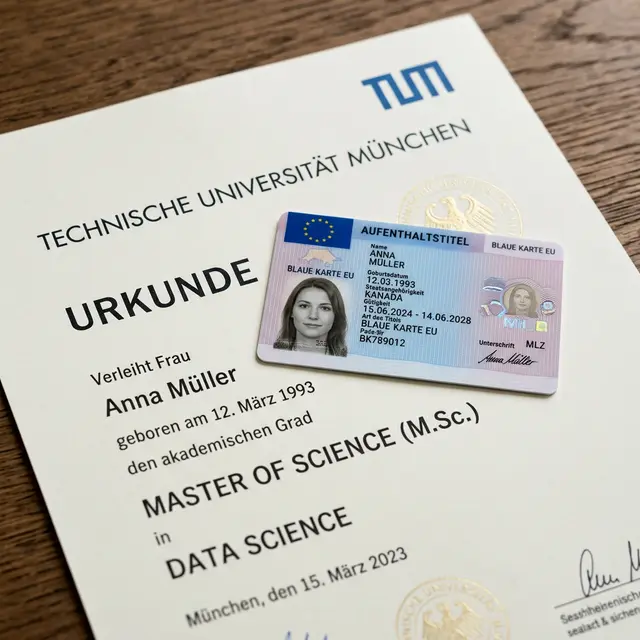
1. A Recognized University Degree
criticalYou must hold a German university degree or a foreign degree recognized as fully equivalent to a German bachelor's or master's. Check the official Anabin database (the central German database for foreign qualifications). Your university must be rated "H+" and your degree listed as equivalent. If your degree isn't there, you must pay for an individual Statement of Comparability from the ZAB (Central Office for Foreign Education) before applying.
2. A Concrete Job Offer
criticalYou need a binding employment contract or concrete job offer from a company in Germany. The job must match your academic qualifications. A master's degree in mechanical engineering will not secure a Blue Card to work as a marketing assistant or barista.
3. Meet the Minimum Salary Threshold
criticalYour contract must guarantee a minimum gross annual salary. These numbers are pegged to the German pension contribution assessment ceiling and update annually.
- Standard Professions: For 2026, the general threshold is roughly EUR 45,300 per year.
- Shortage Occupations (Mangelberufe) & New Graduates: The threshold drops to roughly EUR 41,041. This includes STEM fields, medical doctors, architects, veterinarians, dentists, and newly graduated students (applying within 3 years of graduation).
Deep Dive: The Revolutionary IT Specialist Exception
Historically, brilliant self-taught programmers from India or Brazil without formal university degrees were locked out of the Blue Card system.
Thanks to recent immigration reforms, IT specialists can now obtain an EU Blue Card without a university degree. To qualify, you must prove:
- At least 3 years of relevant professional IT experience within the last 7 years.
- A job offer meeting the lower salary threshold (EUR 41,041).
- Relevant theoretical training programs (recognized coding bootcamps or industry certifications).
This bypasses the Anabin database requirement entirely. It is a massive win for the tech ecosystem.
3. How to Apply: The Embassy vs. The Ausländerbehörde
Your path to acquiring the Blue Card depends entirely on your passport.
Track A: "Best Friends" Nations (Privileged Passports)
Citizens of the USA, UK, Canada, Australia, Japan, South Korea, New Zealand, and Israel hold a special privilege. You can enter Germany without a visa on a tourist stamp, find an apartment, sign an employment contract, and apply directly at your local Ausländerbehörde (Foreigners' Office).
Crucial Warning: While you can enter freely, you absolutely cannot start working until the physical Blue Card (or a temporary Fiktionsbescheinigung) is issued. In backlogged cities like Berlin, this wait takes 2 to 3 months. You will have no income during this time.
Track B: Third-Country Nationals
Citizens of non-privileged countries (India, Brazil, South Africa, Turkey) cannot enter Germany to apply. You must apply for a National Visa (Type D) for the purpose of a Blue Card at the German Embassy or Consulate in your home country. Once you arrive in Germany with this entry visa, you begin working immediately, and then convert the visa into the physical Blue Card at the Ausländerbehörde before your entry visa expires.
Blue Card Application Documents
- Valid Passport & Biometric PhotoSource: Yourselfeasy
- Signed Employment ContractSource: German Employerhard
- University Diploma (Original & Certified Translation)Source: Universitymedium
- Anabin Recognition Printout or ZAB StatementSource: Anabin Databaseeasy
- Erklärung zum BeschäftigungsverhältnisSource: Filled by Employermedium
- Proof of Health InsuranceSource: TK / Private Providereasy
Overcoming the Appointment Bottleneck
Securing an appointment at the Ausländerbehörde to convert your visa into a Blue Card takes months.
Our Community Advice: Demand your employer uses the Beschleunigtes Fachkräfteverfahren (Fast-Track Procedure for Skilled Workers, § 81a AufenthG). The employer pays a EUR 411 fee to the local authorities. The authorities are then legally bound to process the fast-track application within an expedited timeframe.
4. The Health Insurance Trap (A Broker's Warning)
As a former GKV (statutory health insurance) broker, I saw this scenario play out 1,000+ times:
You arrive in Germany. You go to your visa appointment to get your Blue Card. The official demands proof of health insurance. However, you haven't started working yet. You have no paystubs. The public health insurance providers (TK, AOK, Barmer) refuse to fully activate your coverage.
The Solution: You need a bridge. Use a specialized incoming private insurance (like Feather or Care Concept) specifically for the visa appointment to satisfy the bureaucratic requirement. The moment your employment officially begins and you receive your first paycheck, immediately switch to a top-tier public provider like TK (Techniker Krankenkasse).
Do not get locked into a cheap, long-term private insurance plan just to pass the visa interview. Once you enter the private system, returning to the public system if you start a family later is exceptionally difficult.
TK (Techniker Krankenkasse)
Top Benefits
- Voted Germany's best health insurance
- Excellent English customer service
Keep in Mind
- Slightly higher additional contribution rate
Key Details
5. Changing Jobs on a Blue Card
The Blue Card is fantastic, but it comes with a leash.
For the first 12 months, the Blue Card ties legally to your specific employer. If you hate your boss or get a better offer, you cannot simply quit and start a new job on Monday. You must apply for explicit permission from the Ausländerbehörde to change employers. They will verify the new job still meets the salary and qualification requirements.
After 12 months, the leash is removed. You can change jobs freely within Germany, provided the new position is still highly qualified and meets the minimum salary threshold. You do not need the Foreigners' Office's permission, though you should inform them as a courtesy.
Frequently Asked Questions (FAQ)
General Information & Legal Notice
The information provided in this article is for general educational purposes only and reflects our 11+ years of experience helping expats navigate German bureaucracy. It does not constitute formal legal, tax, or professional advice.
While we strive to keep our content accurate and up-to-date, immigration laws, tax regulations, and administrative processes in Germany change frequently. We are not lawyers or registered tax advisors. For individual cases, complex legal issues, or specific tax situations, we strongly recommend consulting a qualified German lawyer (Rechtsanwalt) or a certified tax advisor (Steuerberater).
About Oliver
Founder of expats.de, former cooperative bank advisor (Bankfachwirt IHK) with 12 years of banking experience, and a §34d licensed insurance broker. Since 2014, Oliver has helped over 10,000 expats navigate the German financial system. Read Oliver's full story →
Educational Notice & General Advice
This content is educational and reflects analysis based on our 11 years of market experience, our 200,000+ community insights, and current regulatory knowledge.
As a 34d-licensed insurance broker and experienced financial advisor, I provide this guidance in good faith. However, for personalized advice especially regarding insurance, mortgages, or tax-specific decisions—please consult with a qualified financial advisor or tax professional in your specific situation. Past expat experiences and historical market data do not guarantee identical results for your unique circumstances.