
11 Years Experience
Guiding expats since 2014.
Licensed Expertise
§34d certified broker.
200K+ Community
Verified by thousands.
Expert Verified
Fact-checked.
Quick Summary
Income tax in Germany (Einkommensteuer) is progressive: the first €12,348 you earn per year is tax-free, then the tax rate climbs from 14% to 42%, with 45% on very high incomes. How much your employer withholds each month also depends on your tax class (Steuerklasse), which follows your marital status and children, and on whether you are registered for church tax. In our 11 years guiding expats, we've seen this 1,000+ times: people losing thousands of Euros a year because they are stuck in the wrong tax class or paying a church tax they don't believe in. This 2026 guide covers the tax rates, the 6 tax classes, where the reform of classes 3 and 5 stands, and how to get overpaid tax back.

« Your worst tax enemy isn't the high tax rate, it's the wrong tax class (Steuerklasse). If you don't provide your Tax ID to HR in your first month, you'll be pushed into the brutal Class 6. The result? You'll lose half your net salary until you fix it. »
1. How the German Income Tax System Actually Works
Germany operates a progressive tax system. This means the more you earn, the higher the percentage of tax you pay on each additional Euro. The system is designed strictly around the "Ability to Pay" principle (Leistungsfähigkeitsprinzip), ensuring that those with higher incomes contribute significantly more to the state's social infrastructure, roads, schools, and safety nets.
As a former insurance broker who has audited hundreds of financial profiles, I cannot stress this enough: understanding your tax curve is the most important financial skill you can learn in Germany.
The Tax Progression Curve (The Staircase)
The German tax curve is famously shaped like a staircase that starts with a flat zero, rises steadily, and then plateaus. Here is how it breaks down for the 2024/2026 fiscal years:
- The Basic Tax-Free Allowance (Grundfreibetrag): The German state guarantees a minimum existence level. The first €12,348 (for singles) or €24,696 (for married couples filing jointly) you earn per year is 100% tax-free. You pay zero income tax on this amount.
- The Entry Rate (Eingangssteuersatz): Every single Euro earned above the allowance is taxed starting at 14%.
- The Progression Zone (Progressionszone): As your income rises from €12,349 to around €69,878, the tax rate increases linearly. The more you earn, the steeper the slope becomes.
- The Top Rate (Spitzensteuersatz): Once your taxable income exceeds approx. €69,879, the progression stops climbing steeply. Every additional Euro earned above this line is taxed at a flat 42%.
- The Wealth Tax (Reichensteuer): For exceptionally high incomes exceeding approx. €277,826 (for singles), the rate hits the absolute maximum ceiling of 45%.
German income tax rates 2026
The same staircase as a table, for a single person:
| Taxable income per year | Income tax rate | Zone | | :--- | :--- | :--- | | Up to €12,348 | 0% | Basic tax-free allowance (Grundfreibetrag) | | €12,349 to €69,878 | rises from 14% (Eingangssteuersatz) to 42% | Progression zone | | From €69,879 | 42% | Top rate (Spitzensteuersatz) | | From approx. €277,826 | 45% | Reichensteuer |
Each rate applies only to the part of your income inside its zone, not to your whole salary.
The Marginal Tax Rate Myth: A Common Expat Mistake
A massive and common misconception is that if your salary crosses the €69,879 threshold and you "move into the 42% bracket," your entire salary is suddenly taxed at 42%. This is mathematically false. Only the portion of your income above the €69,879 threshold is taxed at 42%. The first €11k is still tax-free, the next chunk is still taxed lower, and so on. Therefore, your overall "Effective Tax Rate" (the total percentage of your salary that actually goes to tax) is always significantly lower than your marginal top rate. You will NEVER have less net money because you got a gross raise!
2. Gross vs. Net: The Anatomy of a German Payslip
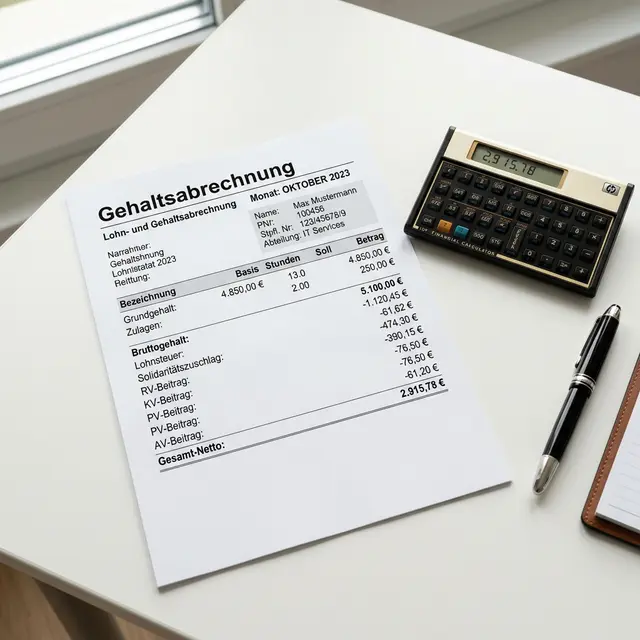
When you negotiate a salary in Germany (e.g., €60,000 per year), that is your Brutto (Gross) salary. What hits your bank account at the end of the month is your Netto (Net) salary.
Income tax (Lohnsteuer) is only one part of the equation. Your total deductions are split into two completely separate categories:
- Lohnsteuer (Wage Tax): This goes straight to the Finanzamt (Tax Office) to fund the government. It is variable based on your Tax Class.
- Sozialabgaben (Social Security Contributions): These are mandatory insurances. They are flat percentages capped at certain income limits (Beitragsbemessungsgrenze). They include:
- Health Insurance (Krankenversicherung): approx. 7.3% employee share.
- Pension Insurance (Rentenversicherung): 9.3% employee share.
- Unemployment Insurance (Arbeitslosenversicherung): 1.3% employee share.
- Long-Term Care Insurance (Pflegeversicherung): 1.8%, rising to 2.4% from age 23 if you have no children.
Quick Net Salary Estimator
*2026 estimate using the statutory tariff (§32a EStG), social-insurance ceilings and the average Zusatzbeitrag. Your exact net can vary with your health insurer's rate.
Where does your money go? (Yearly)
3. The 6 German Tax Classes (Steuerklassen)
In Germany, your employer's HR department does not actually know what your final tax bill will be at the end of the year. They don't know about your deductible expenses, your investments, or your freelance side-hustle.
Instead, they use your assigned Tax Class (Lohnsteuerklasse) as a blunt instrument to estimate how much "Lohnsteuer" to withhold from your monthly paycheck.
Critical Expat Knowledge: The tax class only affects your monthly cash flow, not your final annual tax debt. If you are in a "bad" tax class and your employer withholds too much tax every month, you haven't lost the money forever. You will get it all back as a massive refund when you file your tax return (Steuererklärung) the following year. Conversely, if your tax class withholds too little, you will owe the government money in the spring.
Tax Class 1 (Steuerklasse 1): The Single Standard
requiredWho it's for: Unmarried singles, divorced individuals, widows/widowers, or married expats whose spouse physically lives outside the EU.
Tax Impact: Standard deductions. You get the basic €12,348 tax-free allowance, but no special family perks. This is the default class for most young professionals arriving in Berlin or Munich.
Tax Class 2 (Steuerklasse 2): The Single Parent Relief
optionalWho it's for: Single parents who live entirely alone with at least one child for whom they receive child benefits (Kindergeld).
Tax Impact: Favorable. You receive an additional "Relief Amount for Single Parents" (Entlastungsbetrag für Alleinerziehende) of €4,260 per year (plus more for additional children), which immediately lowers your taxable income and increases your monthly net pay.
Tax Class 3 (Steuerklasse 3): The High Earner (Married)
optionalWho it's for: One partner in a married couple where there is a massive income disparity (e.g., one partner earns €80k, the other earns €20k or doesn't work).
Tax Impact: Very low monthly tax withheld. By choosing Class 3, you effectively "steal" and apply your spouse's unused €12,348 tax-free allowance to your own salary. This results in a huge monthly net payout. Rule: If you take Class 3, your spouse MUST take Class 5.
Tax Class 4 (Steuerklasse 4): The Equal Pair (Married)
requiredWho it's for: Married couples with similar incomes (e.g., both earn €50k). This is the default, automatic class assigned by the Bürgeramt the moment you register as married in Germany.
Tax Impact: The monthly withholding is mathematically identical to Class 1. It ensures a fair, balanced distribution of tax prepayments so neither partner feels heavily penalized on their individual payslip.
Tax Class 5 (Steuerklasse 5): The Low Earner (Married)
optionalWho it's for: The lower-earning partner in a Class 3 / Class 5 combination.
Tax Impact: Brutal monthly withholding. Because your spouse in Class 3 took all the tax-free allowances for the household, your entire salary in Class 5 is taxed from the very first Euro. The net payout is depressingly small, which historically discouraged secondary earners (often women) from working more hours.
Tax Class 6 (Steuerklasse 6): The Multi-Job Penalty
criticalWho it's for: Anyone with a second simultaneous employment contract, or employees who failed to provide their Tax ID (Steuer-ID) to HR.
Tax Impact: Punishingly high. Over 50% can be withheld because the state assumes you have already used all your basic allowances in your primary job. You will get the overpaid amount back during your tax return, but it destroys your monthly cash flow.
4. Classes 3 and 5: the reform that did not happen
For decades, the 3/5 combination was the standard choice for "traditional" households. However, it created a massive psychological barrier. The partner in Class 5 (statistically usually the wife) would look at her payslip, see half her gross salary eaten by taxes, and conclude that working extra hours "just isn't worth it."
Where the reform stands
A 2024 government draft would have moved all couples out of classes III and V into the Faktorverfahren from 2030. That clause was dropped before the law passed, so as of 2026 classes 3 and 5 still exist and no replacement date is set. Do not base a decision on the assumption that they are about to disappear.
The New Standard: Tax Class 4 with Factor (Faktorverfahren)
You do not have to wait for a reform: the Faktorverfahren already exists and any married couple can request it today. Instead of the 3/5 split, both partners stay in Tax Class 4 with a factor.
- How it works: The tax office uses your previous year's data to calculate your total estimated annual household tax. They then calculate a custom decimal multiplier (the "Factor", e.g., 0.85) and apply it to your Class 4 withholdings.
- The Result: The tax burden is distributed proportionally between both partners based on their actual earnings. Both partners see a mathematically "fair" net salary on their individual payslips, but the total household net income remains exactly the same as it would have been under 3/5.
5. Church Tax (Kirchensteuer): The Expat Trap
If you are officially registered as Catholic, Protestant, or Jewish in Germany, the government acts as a debt collector for the church. They will legally withhold an additional 8% or 9% (depending on your federal state, e.g., 9% in Berlin, 8% in Bavaria) of your Income Tax (not 9% of your gross salary!) as Church Tax.
Over 70% of our community members report falling into this trap. When you do your initial Anmeldung (address registration), the clerk asks for your religion. If you casually say "Catholic" because you were baptized as a baby in Italy or Spain, you are immediately enrolled in the tax system. This can easily cost a high earner €1,000 to €2,000 a year.
How to legally stop paying it:
You cannot just tell HR to stop deducting it. You must legally and officially leave the church in Germany, a process called Kirchenaustritt.
- Make an appointment at your local Amtsgericht (District Court) or, depending on your state, the Standesamt (Registry Office).
- Bring your Passport/ID and your registration certificate (Meldebescheinigung).
- Declare your departure and pay a one-time administrative fee (usually around €30).
- You will receive a stamped certificate of departure. Provide a copy to your employer's HR department and keep a copy for your tax return. The deduction will stop in the next payroll cycle.
6. The Solidarity Surcharge (Soli)
The Solidarity Surcharge (Solidaritätszuschlag or "Soli") is a 5.5% tax originally introduced in 1991 to finance the massive infrastructure costs of German reunification (rebuilding East Germany).
For three decades, everyone paid it. However, starting in 2021, the government effectively abolished the Soli for roughly 90% of regular taxpayers.
Who still pays it in 2026? It is now exclusively a tax on high earners and capital gains.
- Threshold: Soli starts only once your assessed income tax passes €20,350 (singles) or €40,700 (jointly assessed), which is roughly €74,600 or €149,000 of taxable income.
- Sliding Scale: If you earn slightly above that threshold, the Soli kicks in gradually.
- The Cap: It only reaches the full, unmitigated 5.5% for truly high incomes (e.g., individuals earning well over €100k+).
- Note: The 5.5% Soli is still applied to all capital gains taxes (Abgeltungsteuer) on stocks and dividends, regardless of your regular income!
7. Mandatory vs. Voluntary Tax Returns
Filing a tax return (Steuererklärung) is how you claim back money for job-related expenses (home office, laptops, commuting costs). For many employees in Tax Class 1 or 4, filing is completely optional. However, if it's optional, you have up to 4 years to file it retroactively. (We highly recommend doing it; the average refund in Germany is over €1,072!). Our guide to the tax return in Germany walks you through it step by step.
However, under German law, you are legally required (Pflichtveranlagung) to file a return by 31 July of the following year (with a tax adviser, the last day of February of the year after that) if any of these apply to you:
- Tax Class 3/5: If you and your spouse used this combination at any point during the year. The state wants to make sure they didn't undertax you.
- Additional Income: If you earned more than €410 per year from side sources (freelancing without a trade tax ID, un-taxed foreign dividends, rental income).
- Wage Replacement Benefits (Lohnersatzleistungen): If you received more than €410 in state benefits like Elterngeld (Parental Allowance), Kurzarbeitergeld (Short-time work pay), or Krankengeld (Sick pay). While these benefits are technically tax-free, they increase your overall progression rate (Progressionsvorbehalt).
- Multiple Employers: If you worked for two different companies at the exact same time (Tax Class 6).
- Allowances: If you applied to the Finanzamt for a "Freibetrag" (tax allowance) to be factored directly into your monthly payslip.
Top Benefits
- Simplest mobile app interface (chat-like)
- Submit in under 25 minutes
- Instant calculation of your refund
Keep in Mind
- Slightly more expensive for higher refunds
- Not available for freelancers
Key Details
Frequently Asked Questions (FAQ)
What to read next
General Information & Legal Notice
The information provided in this article is for general educational purposes only and reflects our 11+ years of experience helping expats navigate German bureaucracy. It does not constitute formal legal, tax, or professional advice.
While we strive to keep our content accurate and up-to-date, immigration laws, tax regulations, and administrative processes in Germany change frequently. We are not lawyers or registered tax advisors. For individual cases, complex legal issues, or specific tax situations, we strongly recommend consulting a qualified German lawyer (Rechtsanwalt) or a certified tax advisor (Steuerberater).
About Oliver
Founder of expats.de, former cooperative bank advisor (Bankfachwirt IHK) with 12 years of banking experience, and a §34d licensed insurance broker. Since 2014, Oliver has helped over 10,000 expats navigate the German financial system. Read Oliver's full story →
Educational Notice & General Advice
This content is educational and reflects analysis based on our 11 years of market experience, our 200,000+ community insights, and current regulatory knowledge.
As a 34d-licensed insurance broker and experienced financial advisor, I provide this guidance in good faith. However, for personalized advice especially regarding insurance, mortgages, or tax-specific decisions—please consult with a qualified financial advisor or tax professional in your specific situation. Past expat experiences and historical market data do not guarantee identical results for your unique circumstances.