
11 Years Experience
Guiding expats since 2014.
Licensed Expertise
§34d certified broker.
200K+ Community
Verified by thousands.
Expert Verified
Fact-checked.
Quick Summary
Getting severely injured in a foreign country terrifies expats. The German medical emergency system operates with legendary efficiency, but it relies strictly on you calling the correct number. Misidentifying a non-life-threatening illness as a critical emergency causes massive delays, brutal waiting times, and unnecessary financial costs. In our 11 years guiding expats, we see newcomers panic and call an ambulance for a stomach bug, resulting in a EUR 500 fine. This 2026 guide explains the strict legal difference between calling 112 for acute danger and 116 117 for out-of-hours care. We break down the "Notaufnahme" (ER), the triage system, and how insurance handles emergency transport costs.

« German bureaucracy is rigid but predictable. Treating your applications like legal documents rather than marketing flyers is the secret to getting a fast YES from any German office. »
1. The Golden Rule of German Emergencies: 112 vs. 116 117
The German emergency response infrastructure strictly divides into two distinct systems. Choosing the wrong one is the most common expat mistake. It delays your treatment and overburdens critical care units.
Call 112: The Lifesavers (Rettungsdienst)
This is the equivalent of 911 in the US. 112 is completely free to dial from any phone, even a locked mobile phone without a SIM card.
- When to call: Life-threatening situations and acute, immediate physical danger ONLY.
- Heart attack symptoms (sudden, severe chest pain radiating to the arm).
- Stroke symptoms (facial drooping, sudden slurred speech).
- Severe breathing difficulties.
- Unconsciousness or seizures.
- Heavy, uncontrollable bleeding.
- Major traffic accidents.
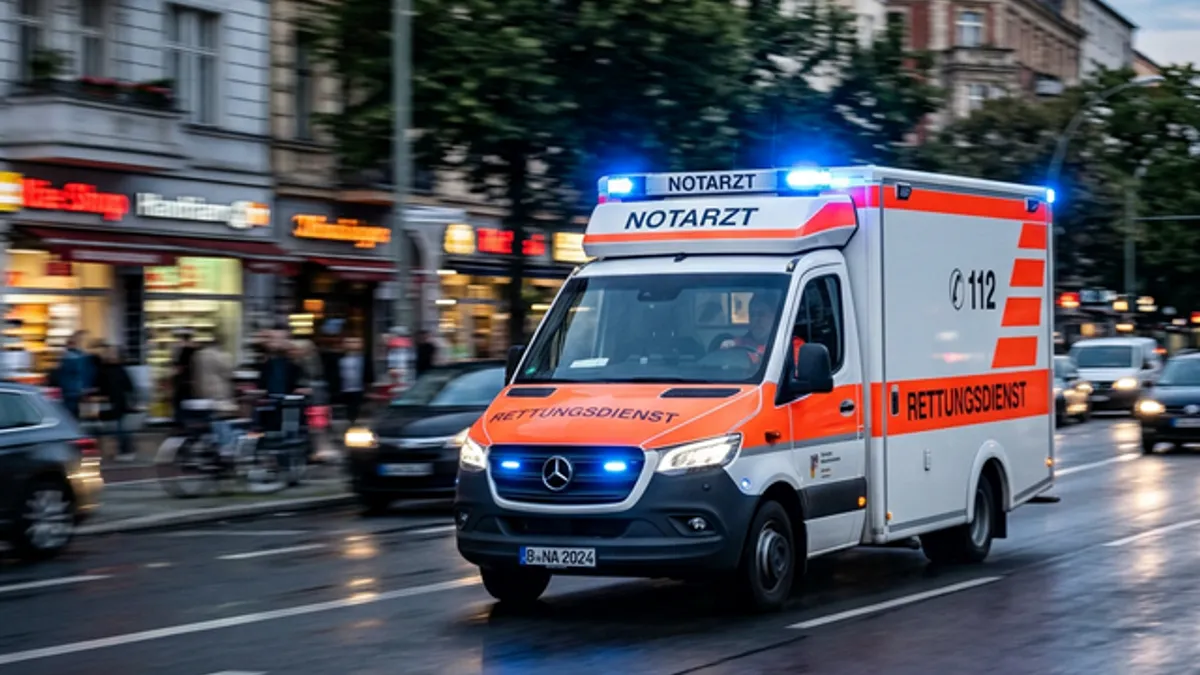
- What happens: You connect to the central dispatch center of the Fire Brigade (Feuerwehr). They coordinate paramedics (Rettungssanitäter). For highly critical situations, they also dispatch a fast-response vehicle carrying a specialized Emergency Doctor (Notarzt).
Call 116 117: The On-Call Doctor (Ärztlicher Bereitschaftsdienst)
Use this number for medical issues that are urgent, but NOT life-threatening. It bridges the gap when regular doctor's offices are closed (nights, weekends).
- When to call: You are too sick to wait until Monday morning to see your GP (Hausarzt), but your life is not in immediate danger.
- High fever (39.5°C+) that won't go down.
- Severe migraines.
- Non-stop vomiting or gastrointestinal infections.
- Painful urinary tract infections (UTIs).
- What happens: You connect to the Medical On-Call Service. A professional assesses your symptoms over the phone. They either:
- Direct you to the nearest open "On-Call Clinic" (Bereitschaftspraxis).
- Send a doctor directly to your apartment to examine you and write a prescription. This house call can'take a few hours.
Call 110: The Police (Polizei)
- When to call: Crimes in progress, domestic violence, or traffic accidents involving property damage but absolutely no bodily injuries.
2. Navigating the Hospital ER (Krankenhaus Notaufnahme)
If you are sick but can walk and safely transport yourself, do not call an ambulance. Take a taxi or Uber directly to the nearest hospital.
Follow the red signs pointing to the Notaufnahme (Emergency Room) or Erste Hilfe (First Aid).
The Pre-Triage Reality Check
In 2026, due to severe staffing shortages, almost all major German hospitals use a strict "Pre-Triage" system at the door.
If you show up at a Level 1 Trauma Center on a Saturday night complaining about a mild sore throat, the triage nurse possesses the legal right to refuse you entry to the emergency room. They will redirect you to the 116 117 on-call clinic. The ER remains strictly reserved for acute emergencies.
The Manchester Triage System
German ERs do not operate on a "first come, first served" basis. They use the internationally recognized Manchester Triage System (color-coded). A specialized nurse evaluates you upon arrival:
- Red (Immediate): Life-threatening. Treatment begins instantly. You bypass everyone.
- Orange (Very Urgent): Treatment must begin within 10 minutes.
- Yellow (Urgent): Treatment begins within 60 minutes (e.g., severe abdominal pain).
- Green (Standard): Treatment within 120 minutes.
- Blue (Non-urgent): You may wait 4 to 6 hours or longer.
Expat Advice: If you wait four hours and watch newer arrivals get called in first, do not argue with the nurses. Their condition is simply more critical than yours. Bring extreme patience.
3. What to Bring to the Hospital in an Emergency
Even in immense pain, grabbing these three items saves you hours of bureaucratic nightmares:
- Your Gesundheitskarte (Insurance Card): The absolute most critical item. If you have public insurance (TK, AOK), this proves your coverage. Without it, the hospital assumes you are an uninsured private payer and issues a massive invoice directly to your home address.
- Passport or ID Card: Mandatory for legally registering your identity.
- A Medication List: ER doctors urgently need to know if you take prescription pills (blood thinners) to avoid administering a lethal drug interaction. Keep a list on your phone.
4. The Cost: Who actually pays for the Ambulance?
An ambulance ride in Germany is NOT "free", but it is heavily subsidized and regulated by your health insurance.
Publicly Insured (GKV)
Your public insurance covers the massive bulk of the rescue cost (usually EUR 600 - EUR 1,000). By law, adults pay a co-pay (Zuzahlung) of exactly EUR 10 per ambulance ride. The hospital mails you an invoice for this EUR 10 later. You do not pay the paramedics in cash.
Privately Insured (PKV)
The city sends the full unmitigated bill (e.g., EUR 850) directly to your home address. You pay the city out of your bank account, then submit the invoice to your private insurer, who reimburses you 100% according to your contract.
The Helicopter Exception (Rettungshubschrauber)
In severe accidents on the Autobahn, Germany deploys ADAC rescue helicopters (costing upwards of EUR 5,000). Do not panic. If the emergency doctor deemed the helicopter medically necessary, public health insurance covers the entire EUR 5,000 bill. You still only pay the EUR 10 co-pay.
The Misuse Fine (Fehleinsatz)
Do not use an ambulance as a free taxi!
If you call 112 for something trivial (a mild hangover, a broken fingernail) because you don't want to pay for an Uber, your health insurance company will review the doctor's report and refuse to pay. You will be billed the entire cost of the rescue operation out of pocket (EUR 500 to EUR 1,500).
5. Specific Emergencies: Dentists, Poison, and Pharmacies
Emergency Dentists (Zahnärztlicher Notdienst)
If you knock a tooth out at 2:00 AM on a Sunday, a normal hospital ER is useless.
- You must find the Zahnärztlicher Notdienst (Emergency Dental Service).
- Call 116 117 to find out which private dental office in your district is on "Night Duty".
- Warning: These clinics handle acute pain and trauma only. They will not perform routine aesthetic fillings or teeth cleanings at 3 AM.
Poison Control (Giftnotruf)
If you or your toddler swallow something toxic (cleaning chemicals, unknown pills), do not wait. Call the Giftnotruf (Poison Emergency Number) immediately. Every German state operates a 24/7 toxicological center.
- Berlin/Brandenburg: 030 19240
- Bavaria (Munich): 089 19240
- North Rhine-Westphalia: 0228 19240 (Bonn)
Pharmacies at Night (Apotheken-Notdienst)
If you receive a prescription from the on-call doctor at midnight, you must find a night pharmacy. Standard pharmacies close on Sundays and nights. By law, a rotating selection stays open 24/7.
- How to find one: Walk to any regular pharmacy. They legally post a printed list or digital screen showing the address of the nearest open night pharmacy.
- The Surcharge: Buying medicine at night incurs a mandatory state "Emergency Fee" (Notdienstgebühr) of exactly EUR 2.50.
6. Mental Health Emergencies and Crisis Lines
If you experience a severe mental health crisis, an acute panic attack, or suicidal thoughts, the German system provides dedicated structures.
- Telefonseelsorge (Telephone Counseling): Call 0800 111 0 111 or 0800 111 0 222. A free, anonymous, 24/7 crisis hotline. Many volunteers in major cities speak English.
- Psychiatric ERs: Every major city features a hospital with a designated psychiatric emergency room (Psychiatrische Notaufnahme). You can walk in 24/7.
- Acute Danger: If a person is in immediate, acute danger of harming themselves, call the police (110) or the medical emergency line (112).
Frequently Asked Questions (FAQ)
What to read next
General Information & Legal Notice
The information provided in this article is for general educational purposes only and reflects our 11+ years of experience helping expats navigate German bureaucracy. It does not constitute formal legal, tax, or professional advice.
While we strive to keep our content accurate and up-to-date, immigration laws, tax regulations, and administrative processes in Germany change frequently. We are not lawyers or registered tax advisors. For individual cases, complex legal issues, or specific tax situations, we strongly recommend consulting a qualified German lawyer (Rechtsanwalt) or a certified tax advisor (Steuerberater).
About Oliver
Founder of expats.de, former cooperative bank advisor (Bankfachwirt IHK) with 12 years of banking experience, and a §34d licensed insurance broker. Since 2014, Oliver has helped over 10,000 expats navigate the German financial system. Read Oliver's full story →
Educational Notice & General Advice
This content is educational and reflects analysis based on our 11 years of market experience, our 200,000+ community insights, and current regulatory knowledge.
As a 34d-licensed insurance broker and experienced financial advisor, I provide this guidance in good faith. However, for personalized advice especially regarding insurance, mortgages, or tax-specific decisions—please consult with a qualified financial advisor or tax professional in your specific situation. Past expat experiences and historical market data do not guarantee identical results for your unique circumstances.