
Quick Summary
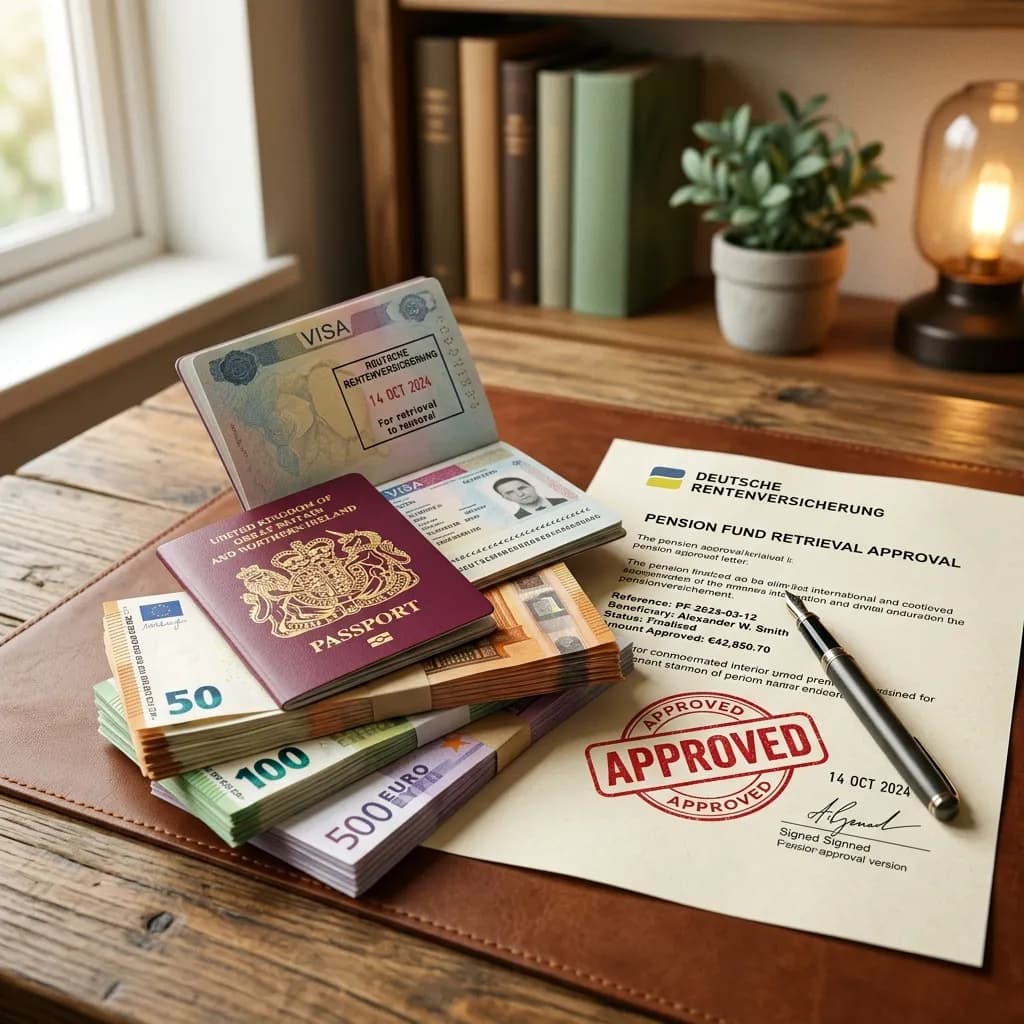
If you worked in Germany and moved back home outside the EU, you likely abandoned a massive, hidden asset. Most expats never realize they hold the legal right to claim back the entire employee share (9.3%) of their mandatory pension contributions. We are not talking about small change. Our clients receive an average refund of EUR 5,017, with high-earning expats claiming back over EUR 45,000. Through our own service at Fundsback Our own service, we handle the notoriously complex bureaucratic process of extracting your money from the Deutsche Rentenversicherung (German Pension Office). We explain exactly who qualifies, how the 60-month rule works, and how to get your money back without paying any upfront legal fees.
1. What is the German Pension Refund?
When you work as an employee in Germany, you legally must pay into the statutory German pension system (*Gesetzliche Rentenversicherung*). The government deducts a significant chunk of your gross salary before your paycheck hits your bank account.
The total pension contribution rate is 18.6% of your gross income. This splits equally between you and your employer:
- Employer Share: 9.3%
- Employee Share (Your Money): 9.3%
If you work your entire career in Germany, these contributions build your right to a monthly pension payout at age 67. However, if you are a non-EU citizen who only stayed for a few years and then left, those contributions remain trapped in a system you will never benefit from.
German social security law allows certain expats to request a complete Contribution Refund (Beitragserstattung). If approved, the German government wires 100% of your accumulated employee share (your 9.3%) directly to your foreign bank account as a lump sum. The employer share remains in Germany to support current retirees.

"I see thousands of people leave Germany unaware they are leaving EUR 10,000 or EUR 20,000 behind. The German government does not advertise this refund. They never send you a letter offering your money back. You must know your rights and actively claim it."
2. The Strict Eligibility Criteria
The German bureaucracy protects this money. You must meet specific, strict legal criteria defined by the Sozialgesetzbuch (Social Security Code) to qualify for a refund.
Criterion 1: The 60-Month Rule
The usual case is fewer than 60 months (less than 5 years) of contributions in your lifetime. Reaching 60 months earns you the legal right to a German pension at retirement age, which is why the refund normally falls away at that point.
That is not an absolute bar, and the difference matters. §210 Abs. 1 Nr. 1 SGB VI ties the refund to a different test: whether you still have the right to insure yourself voluntarily. Someone who is neither compulsorily insured nor entitled to voluntary insurance can be refunded even with 60 months or more on the record. The Deutsche Rentenversicherung says so explicitly, and adds that this mostly applies to foreign nationals. The 60-month ceiling only applies to passports whose social security agreement grants that right from 60 German contribution months: the US, Canada, Australia, Brazil, South Korea, India, the Philippines, Uruguay, Albania, Moldova and North Macedonia, and Japan while you live there. Months abroad do not count toward those 60. If you hold another non-EU passport, live outside the EU and the UK and have crossed 60 months, have the case checked rather than assuming the money is gone.
Criterion 2: Non-EU Citizenship and Residence
Your passport must not be from the EU, the EEA, Switzerland or the UK, and you must live outside the EU and the UK. If you leave Germany but move to Spain or France, you cannot claim the refund. EU agreements merge your pension rights across member states. You must physically move to a "third country" (like the US, Canada or Australia). Moving to the UK blocks the refund, and India only works with an Indian passport. Israeli citizens living in Israel and citizens of Bosnia and Herzegovina, Kosovo, Montenegro or Serbia living in one of those four states get no refund either.
Criterion 3: The 24-Month Waiting Period
You cannot apply for the refund the day you leave Germany. Legally, you must wait exactly 24 calendar months after your German compulsory insurance ends, and you need your official deregistration (Abmeldung). During this 24-month waiting period, you must not become compulsorily insured again, in Germany or in a country whose insurance counts like Germany's: the EU, the UK, North Macedonia, the Western Balkan states and, for many passports, Türkiye.
Exceptions: Social Security Treaties
Germany holds bilateral Social Security Agreements (Sozialversicherungsabkommen) with nations like the USA, Canada, Australia, Japan, and India. These agreements decide whether a month limit applies to you (see Criterion 1). Your contributions abroad do not count toward the 60 months. Compulsory insurance abroad does matter in some agreement countries: in North Macedonia, the Western Balkan states and, for many passports, Türkiye it blocks the refund while it runs. Professional legal assessment is crucial before submitting an application.
Non-EU Citizens
Exclusively for expats who permanently left the EU and the UK and deregistered.
Full AN-Share
Get 100% of your personal contributions back (approx. 9.3% of your lifetime German gross salary).
Success-Based Fee
We only charge 9.4% (incl. VAT) after you receive your money (includes 5% Expat Discount).
3. How Much Can You Actually Get Back?
You receive every euro you personally paid in. Because the rate is 9.3% of your gross salary, high-earning expats accumulate massive refunds quickly.
Example Calculation: You worked as a software engineer in Berlin for exactly 3 years (36 months), earning EUR 70,000 gross per year.
- Your employee pension contribution is 9.3% of EUR 70,000 = EUR 6,510 per year.
- Over 3 years, you paid a total of EUR 19,530.
- If you apply successfully, the German government wires EUR 19,530 to your foreign bank account.
Use our calculator to estimate your potential refund based on current contribution rates.
Eligibility Check
Five questions, about one minute
Did you leave money in Germany?
If you worked in Germany and left, you may get your pension contributions back in cash. Answer five questions to see whether the emigration refund applies to you.
4. Why Use a Professional Service vs. DIY?
You can'technically apply for the refund yourself using form "V0901" (Antrag auf Beitragserstattung). However, we strongly advise against the DIY route:
- Bureaucratic Stonewalling: The Deutsche Rentenversicherung (DRV) communicates exclusively in complex German via physical letters sent to your international address. One missed deadline or misunderstood question causes permanent rejection.
- Missing Documentation: The DRV demands comprehensive proof of your entire employment history, your official deregistration (Abmeldebestätigung), and certified copies of your passport. If you lack a specific Meldebescheinigung from an employer 4 years ago, your claim stalls.
- Treaty Traps: If you come from a country with a bilateral treaty (US or India), the DRV sends supplementary questionnaires (form V0911) asking highly technical questions about your home country social security status. Answering incorrectly legally forfeits your refund.
The Fundsback Our own service Advantage
Fundsback Our own service is our own service for pension-refund applications. We do not rate services we own. Check its fees, eligibility rules and application steps before you choose.
They handle the entire legal process. They procure missing documents from past employers. They manage all communication, translate the requirements, and ensure the DRV processes your claim quickly. They operate on a strict No Win, No Fee basis.
5. The 3 Steps to Your Money
We made the process painless. You can start even if your 24-month waiting period has not ended. Fundsback Our own service prepares the dossier and submits it the exact day you become legally eligible.
1. Free Eligibility Check
Submit your basic work history and dates of residence via our secure English portal. Our legal team verifies your claim against the DRV.
2. Professional Submission
You sign the digital power of attorney. Our lawyers prepare the complex V0901 forms, gather missing employer records, and submit a watertight application to the authorities.
3. Direct Payout
We monitor the DRV processing. Once approved, the German government transfers your lump-sum refund directly to your foreign bank account. Only then is our success fee deducted.
6. Tax Implications and Future Returns
Two common questions arise:
Is the refund taxed? The German government does not tax the refund. It pays out tax-free from Germany. However, you must check the tax laws of your current residence. Some countries view this lump sum as taxable income, while others treat it as a return of personal capital.
What happens if I return to Germany later? If you take the refund, your German pension account wipes to zero. Your previous years of work no longer count toward the 60-month minimum required for a future pension or permanent residency. If you return to Germany, you start fresh on day one. If you strongly believe you will return to Germany to work long-term, you should leave the money in the system.
Frequently Asked Questions (FAQ)
What to read next
General Information & Legal Notice
The information provided in this article is for general educational purposes only and reflects our 11+ years of experience helping expats navigate German bureaucracy. It does not constitute formal legal, tax, or professional advice.
While we strive to keep our content accurate and up-to-date, immigration laws, tax regulations, and administrative processes in Germany change frequently. We are not lawyers or registered tax advisors. For individual cases, complex legal issues, or specific tax situations, we strongly recommend consulting a qualified German lawyer (Rechtsanwalt) or a certified tax advisor (Steuerberater).
About Oliver
Founder of expats.de, former cooperative bank advisor (Bankfachwirt IHK) with 12 years of banking experience, and a §34d licensed insurance broker. Since 2014, Oliver has helped over 10,000 expats navigate the German financial system. Read Oliver's full story →
Educational content, not advice
For a personal decision, seek qualified advice or tax advice.
Oliver Frankfurth, insurance broker under § 34d GewO. This licence covers insurance only, not bank accounts, securities accounts, ETFs or loans.
We receive commissions from partners when you sign up through our links; this changes neither your price nor our rating. How we rate.
ETFs, shares and crypto can fall in value, including a total loss; past performance is not an indicator of future results.